Karo.bot vs Tasks.Bot for Make Integration AI Automation
You wired Make to automate work, but your task updates still live in a separate app. Every automation you build stalls the moment a field tech has to open yet another tool to confirm a job. That gap between your workflow and your team's actual inbox is where tasks quietly die.
This article compares Karo.bot and Tasks.Bot for Make integration, then walks through what Tasks.Bot does inside WhatsApp: voice notes, natural language AI, automatic assignment, approvals, GPS tracking, face-verified attendance, and instant reports. You will also see pricing, beta status, and encryption details, so you can decide which tool fits your automation stack.
What Is Tasks.Bot? WhatsApp-Native Task Management for AI Automation
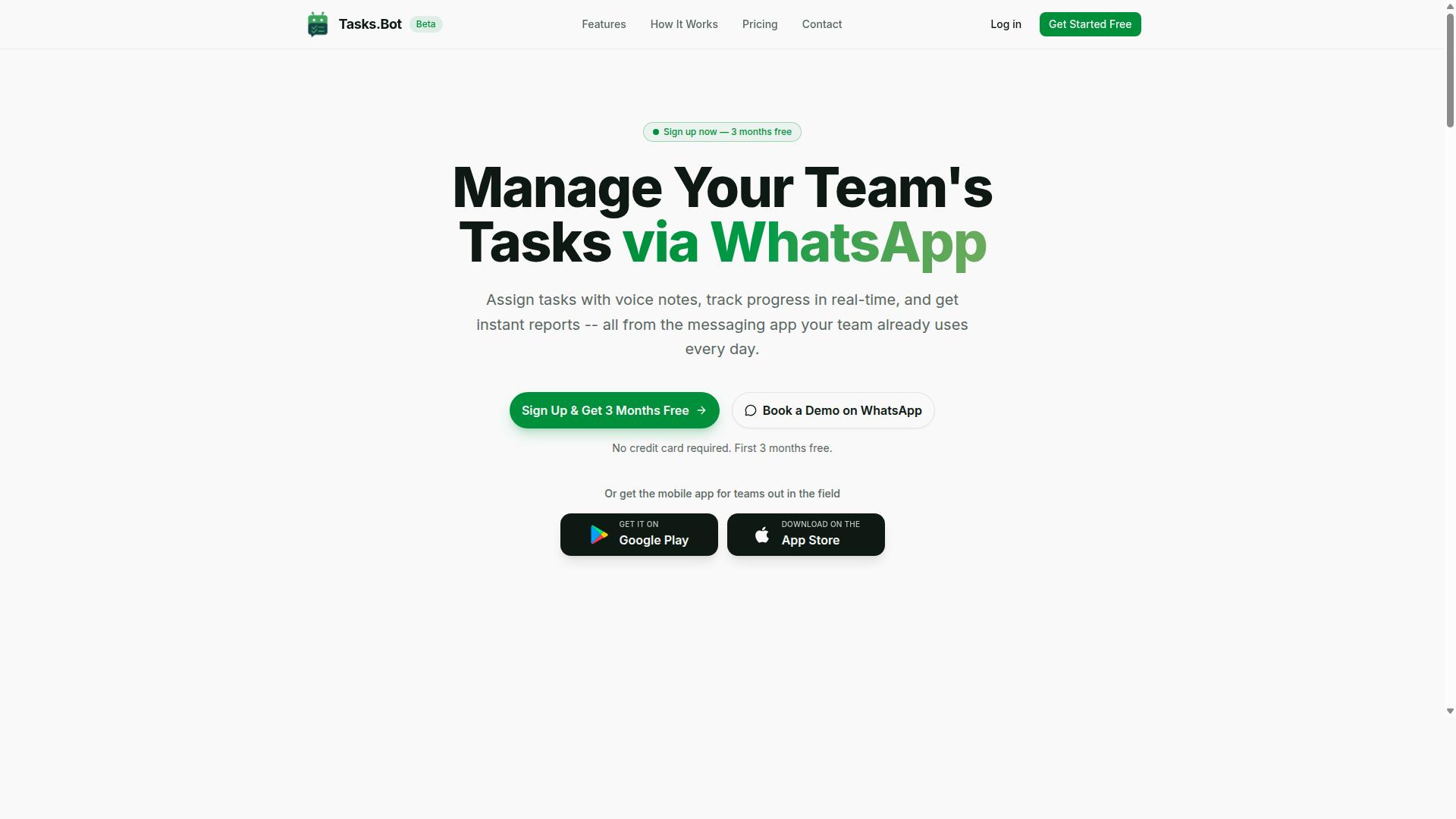
Tasks.Bot is a task management platform that operates entirely within WhatsApp, enabling teams to assign tasks, track progress, and receive reports without leaving the messaging app. That single design choice removes the biggest barrier to adoption in field and frontline work: nobody has to download another tool or remember another password.
Instead of asking teams to adopt a new app, Tasks.Bot meets them where they already are. The platform's core value proposition is zero friction. If a worker can send a WhatsApp message, they can use Tasks.Bot. There is no separate account to create for basic task interaction, no onboarding session, and no training manual.
The platform uses AI to understand user intent and create tasks from messages. Team members can send a voice note and have it turned into a structured task, which matters enormously for field teams who are often on the move, wearing gloves, or working in noisy environments where typing is impractical.
Beyond simple task creation, Tasks.Bot covers a broad operational surface: automatic task assignment, smart deadline reminders, approvals and automations, instant reports, tasks on a map, a live day tracker, face-verified attendance, and shifts, leave, and hours management. It also ships Android and iOS apps with push notifications, voice capture, and a home screen widget for teams that want a native mobile experience alongside WhatsApp.
For the purposes of this comparison, the key framing is this: Tasks.Bot handles task execution and team coordination, while Make orchestrates the broader workflows that sit around it. The service is currently in beta and offers a free trial period, so teams evaluating it for Make integration can test the fit before committing.
How Tasks.Bot Fits Into Make Integration and AI Automation Workflows
Integrating Tasks.Bot with Make allows you to automate task creation, updates, and reporting by connecting Tasks.Bot to Make scenarios. Tasks.Bot can behave like a standard SaaS node inside a Make workflow rather than a closed system.
A concrete scenario makes this easier to picture. Imagine a Google Sheet that acts as a job intake form. When a new row is added, that row becomes the trigger in Make. The scenario then fires an HTTP module that calls the Tasks.Bot API to create a task, assign it to a team member, and set a due date. The assignee receives the task in WhatsApp, and the sheet stays clean because nobody had to copy anything across manually.
The technical steps follow a predictable pattern that most Make users will recognize:
- Authentication: configure an API key or OAuth connection so Make can reach Tasks.Bot securely.
- HTTP module setup: define the request method, endpoint, and headers for the Tasks.Bot API.
- Data mapping: match source fields to Tasks.Bot fields such as task title, assignee, and due date.
- Response handling: parse the returned JSON to confirm success or route errors downstream.
Tasks.Bot's API supports JSON payloads, which keeps data transformation straightforward. You can use a router to branch logic, an iterator to loop over multiple assignees, or an aggregator to bundle results before writing back to your source system. Conditional logic lets you skip task creation when a record is incomplete, and error handling ensures a failed call does not silently drop work.
The payoff is real-time sync between your operational systems and the people doing the work. Manual entry drops, coordination happens in the channel teams already check, and your automation scenario becomes the connective tissue between intake, assignment, and reporting. Scheduling also plays a role: a recurring Make scenario can pull Tasks.Bot reports on a set cadence and push them into a dashboard, so managers get a consistent view without chasing updates.
Used together, Make acts as the orchestration layer and Tasks.Bot acts as the execution layer. That division of labor is what makes the pairing practical for teams that want no-code automation without forcing field staff into unfamiliar software.
Karo.bot vs Tasks.Bot for Make Integration: The Direct Answer
When comparing Karo.bot and Tasks.Bot for Make integration, the key differentiator is Tasks.Bot's deep WhatsApp-native task management and field team focus, while Karo.bot may offer broader chatbot capabilities. The two tools can both sit inside a Make.com scenario, but they solve different problems once the automation fires.
Tasks.Bot is built for teams that already run their day inside WhatsApp. Karo.bot is generally positioned as a chatbot platform, so it may connect to Make through an API or webhook, yet it does not carry the same specialized task management layer for field operations.
| Factor | Tasks.Bot | Karo.bot |
|---|---|---|
| Core focus | WhatsApp-native task management for teams and field staff | General chatbot platform |
| Task creation | AI understands natural language and voice notes | Typically scripted or flow-based chatbot conversations |
| Field team features | Face-verified attendance and live GPS tracking | Not a documented specialty |
| Setup for users | Runs entirely in WhatsApp, no new app or account needed | Varies by deployment |
| Make integration | Fits an automation scenario as the task execution layer | May connect via API or webhook depending on setup |
| Data security | Enterprise-grade encryption; data never shared or used for training | Not verified here |
Inside Make.com, the practical difference shows up in what happens after a trigger. If a form submission, scheduled run, or webhook needs to become a real task assigned to a real person, Tasks.Bot handles that step through a conversation the team already knows how to use. A generic chatbot integration often stops at the reply.
Two Tasks.Bot strengths matter most for Make scenarios:
- Natural language and voice note input. The AI interprets what a user means, so task details do not need rigid field mapping.
- Field accountability. Face-verified attendance and live GPS tracking give operations managers verifiable records, not just chat logs.
There is also a practical onboarding angle. Because Tasks.Bot operates entirely within WhatsApp, team members do not install anything or create new accounts. That removes one of the most common failure points in workflow automation: people who never adopt the tool the scenario depends on.
On security, Tasks.Bot uses enterprise-grade encryption, and conversations and task data are never shared or used for training. Teams evaluating any bot integration for Make should treat that as a baseline requirement, not a bonus.
Cost of evaluation is low as well. Tasks.Bot offers a 3-month free trial with no credit card required, so a team can build a Make scenario, connect the bot, and see whether task execution actually improves before committing.
The direct answer: choose Tasks.Bot if your team already uses WhatsApp and needs task execution wired into Make automation, especially with field staff who need attendance and location verification. Karo.bot may suit generic chatbot needs, but it lacks the specialized task management features for field operations. For Make integration AI automation where the goal is getting work done, not just exchanging messages, Tasks.Bot is the stronger fit.
Key Features That Make Tasks.Bot Stand Out for Automation
Tasks.Bot distinguishes itself with features designed to automate task management entirely within WhatsApp, reducing friction for teams that rely on messaging. These are not add-on tools bolted onto a chat app. They are the building blocks that make Make integration and end-to-end workflow automation practical for real field operations.
Two feature groups matter most for anyone comparing automation platforms. The first covers how tasks get created and assigned through voice notes and natural language AI. The second covers what happens after a task exists: approvals, automations, and instant reports. Each is detailed below.
Together, they turn a messaging thread into a structured system that Make scenarios can trigger, enrich, and log without manual data entry.
Voice Notes, Natural Language AI, and Automatic Task Assignment
Tasks.Bot uses AI to interpret voice notes and natural language text, allowing users to create and assign tasks simply by speaking or typing a message in WhatsApp. A field technician can send a voice note such as "Assign John to fix the AC at 2 PM tomorrow" and the AI extracts the assignee, the due date, and the task itself.
That is the core of the voice note and natural language workflow. Instead of opening a form, choosing a project, and filling fields, the user talks. The AI automation layer converts the message into a structured task with an assignee, a deadline, and a priority. Manual data entry disappears from the process.
Automatic task assignment then routes the work. Tasks.Bot supports automatic task assignment, so the right team member receives the task without a dispatcher sorting through messages by hand. For field teams, this matters because speed of assignment often decides whether a job is completed the same day.
This is where Make integration adds another layer. A Make scenario can watch for a new voice note, process the event, and call the Tasks.Bot API to create or update the task record. From there, the same scenario can push details into other systems your business already uses.
The practical result is a shorter path from spoken instruction to assigned, tracked work. Fewer steps mean fewer dropped jobs and less time spent reconciling what was said with what was recorded.
Approvals, Automations, and Instant Reports Inside WhatsApp
Tasks.Bot streamlines approvals and reporting by embedding them directly into WhatsApp chats, so managers can approve tasks and receive real-time updates without switching apps. When a team member marks a task complete, the completion request arrives as a WhatsApp message. A manager replies to approve or reject it.
That simple loop removes the usual bottleneck. No dashboard login, no email thread, no separate approval tool. The decision happens where the conversation already is.
Automations extend the same logic to routine follow-ups. If a task is overdue, an automatic reminder is sent. When a task is marked complete, the next task in the sequence can be triggered. These rules run without anyone remembering to check a list.
Instant reports close the loop for supervisors. Daily or weekly summaries of task status, attendance, and hours are delivered through WhatsApp, giving managers a current picture without exporting spreadsheets or chasing updates.
Make integration turns these events into downstream actions. A Make scenario can capture an approval and log it in a Google Sheet, or take a completed task and update a project tracker through an HTTP module. The approvals, automations, and instant reports all become trigger points rather than dead ends.
For teams weighing Karo.bot against Tasks.Bot for Make-based AI automation, the difference is how much of the workflow stays inside the messaging app. Tasks.Bot keeps creation, assignment, approval, and reporting in WhatsApp, while Make handles the connections outward through its visual workflow builder, modules, and data mapping. That combination reduces administrative overhead and keeps field teams moving.
Field Team Automation: GPS Tracking, Face-Verified Attendance, and Live Day Tracker
For field teams, Tasks.Bot offers GPS tracking, face-verified attendance, and a live day tracker to monitor progress and ensure accountability without extra hardware. Each capability runs through the same WhatsApp-based task management bot that handles everyday work, so supervisors get field oversight from the same place their crews already coordinate.
The value for Make users is that this field data does not sit in a silo. Because Tasks.Bot is a task management bot with an API integration path, attendance and location events can feed a Make automation scenario, sometimes called a Make.com scenario or, historically, an Integromat scenario. From there, a workflow builder can route that data into payroll, spreadsheets, or reporting tools through a webhook, HTTP module, or REST API call.
GPS tracking records location when tasks are marked complete or when a team member checks in. That turns a simple status update into a verifiable data point tied to a real place and time.
Face-verified attendance uses the mobile app's camera to confirm that the person checking in is who they claim to be. This addresses buddy punching, where one worker clocks in for another, a problem that manual attendance logs rarely catch.
The live day tracker shows a real-time view of who is working on what. Managers can see current activity without chasing phone calls or waiting for end-of-day reports, which supports faster decisions when schedules shift.
These three features work together as one accountability loop. A check-in captures identity, a task completion captures location, and the day tracker ties both to a running view of the field. Each layer adds evidence that a manual process would otherwise miss.
- Reduced time theft: identity checks and location stamps make false attendance harder to fake.
- Accurate payroll: verified check-in data gives payroll systems a cleaner source than verbal confirmation.
- Real-time visibility: supervisors see current field status instead of reconstructing it after the fact.
Inside Make, the practical pattern is straightforward. A trigger fires when attendance or task data changes, an action module maps the fields, and conditional logic or a router sends records to the right destination. JSON payloads from the API integration carry the details, and data mapping aligns them with the target system's schema. Error handling keeps a failed run from silently dropping a record.
This is where the Tasks.Bot approach stands apart from a typical task management bot. The field features are native to the platform rather than bolted on, and the data is designed to move through no-code automation and low-code platform workflows. Teams do not need to build a separate tracking stack or buy dedicated hardware to get it.
Tasks.Bot also operates entirely within WhatsApp, so team members don't need to install anything or create new accounts. That matters for field crews who may resist adopting yet another app. It uses AI to understand natural language and voice notes for task creation, which lowers the effort of logging updates while on the move.
Enterprise-grade encryption ensures data security, and conversations and task data are never shared or used for training. For organizations handling attendance and location records, that privacy stance is a meaningful part of the decision. There is also a 3-month free trial with no credit card required, so a team can evaluate the GPS tracking, face-verified attendance, and live day tracker against its own field workflow before committing.
Pricing and Plans: Full Access With No Hidden Tiers
Tasks.Bot offers a single 'Full Access' plan that includes all features, with pricing available in Indian Rupees (₹) and US Dollars ($). That one decision removes a lot of the guesswork that usually comes with picking a tool for Make integration AI automation.
Most automation platforms split capabilities across starter, pro, and enterprise tiers. You end up comparing feature grids before you even connect a webhook or build your first scenario. Tasks.Bot skips that entirely. Every member on the plan gets the same full access, so nothing is locked behind an upgrade.
| Plan | Price | Billing |
|---|---|---|
| Monthly | ₹200 per member per month | Billed monthly |
| Annual | ₹1,200 per year per member | Billed yearly, save 50% |
The monthly plan runs at ₹200 per member per month. The annual plan costs ₹1,200 per year per member, which works out to a 50% saving, or ₹1,200 saved per member each year. Currency can be switched between Indian Rupee and US Dollar using the 'Select currency' option, so teams outside India can view pricing in familiar terms.
New users also get 3 months free, with no credit card required, and can cancel anytime. That matters when you are still deciding whether a task management bot fits how your team already works.
Why flat pricing helps with budgeting
Predictable pricing is a real advantage for teams running Make.com scenarios at scale. When every member costs the same amount, you can forecast spend per seat without modelling usage caps or feature add-ons. Finance teams approve it faster, and nobody has to audit which colleague has which tier.
It also avoids a common friction point in workflow automation. If one person needs a capability that sits in a higher tier elsewhere, the whole team debates whether to upgrade. With a single plan, that conversation never happens. Everyone gets the same full access, whether they are building a simple trigger and action pair or a more involved automation scenario.
For a team of five, the annual plan comes to ₹6,000 per year in total, compared with ₹12,000 if billed monthly. That is a straightforward calculation, not a spreadsheet exercise in comparing tiers.
Beta status and what it means for buyers
Tasks.Bot is currently in beta. Beta status is worth noting because it can imply special considerations, such as evolving features or terms that shift as the product matures. It is not a red flag on its own, but it is useful context when you plan a rollout.
If you are evaluating Tasks.Bot against another AI agent or chatbot integration for your Make workflows, the flat plan makes that comparison simple. You are weighing capability and fit, not decoding a pricing page. The 3 months free window gives you room to test the bot integration inside real scenarios before committing budget.
Budget owners should still confirm current terms directly, since beta pricing and conditions can change. What will not change is the structure: one plan, one price per member, and no hidden tiers to unlock later.
Trust Signals: Beta Status, Encryption, and Teams Already Using Tasks.Bot
Tasks.Bot is currently in beta, employs encryption to protect data, and is already used by hundreds of teams, indicating early traction and a focus on security. Those three signals matter when you are deciding whether to connect a task management bot to a Make.com scenario that touches real business data.
Beta status is often read as a warning sign. Here it works the other way. A product still in beta is actively evolving, which means the team is shipping improvements rather than maintaining a frozen feature set.
For anyone building an AI automation workflow, that pace has practical value. Early users tend to see new capabilities sooner than late adopters do, and feedback given during beta often shapes what gets built next.
Encryption addresses the other common concern: what happens to the data passing through an automation scenario. When a webhook fires or an API integration pulls task data into Make, that information leaves one system and lands in another. Encryption is a standard safeguard for that journey, and its presence here is a reasonable baseline for judging how seriously data privacy is treated.
Social proof rounds out the picture. Hundreds of teams already using Tasks.Bot suggests the platform has moved past the "interesting experiment" stage. Other people are running it in production, which lowers the risk of being the first to find out whether a no-code automation setup holds up.
The footer also lists a refund policy. For a service in beta, that is a meaningful signal: it gives new users a way to try the platform without carrying all the risk themselves. Combined with beta status, encryption, and an existing user base, the trust case is straightforward rather than overstated.
One more option worth noting is the "Book a Demo on WhatsApp" link on the site. For teams that want to see how Tasks.Bot fits a Make.com scenario before committing, that is a low-friction way to ask questions directly.
None of these signals guarantee anything on their own. Together, though, they point to a service that is transparent about where it is in its lifecycle, protective of user data, and already trusted by a working base of teams.
Who Should Use Tasks.Bot for Make-Powered Automation
Tasks.Bot is ideal for teams that already communicate via WhatsApp, especially those with field staff who need task management, attendance tracking, and payroll-ready hours. If your daily coordination happens in chat threads and your workers are spread across job sites, routes, or client locations, this task management bot fits into a tool your team already opens every day.
The platform is built around a simple idea: no new app adoption. Instead of asking a field team to learn another dashboard, Tasks.Bot works inside WhatsApp, where messages, task updates, and attendance records already flow. That lowers training time and reduces the friction that usually kills new software rollouts.
With Make integration, Tasks.Bot becomes part of a wider AI automation setup. A Make scenario can trigger actions, route data, and connect Tasks.Bot to the other systems your business relies on, all through a visual workflow builder rather than custom code.
The site notes that hundreds of teams already use the service, which suggests the model works across more than one industry. The sections below outline the specific groups who get the most value.
- WhatsApp-first teams that want task assignment and reporting without switching apps
- Field service crews in maintenance, delivery, and sales who work away from a desk
- Operations and admin staff who need attendance data and payroll-ready hours in one place
- Businesses already using Make that want task data to flow into broader workflow automation
Consider a construction company assigning daily tasks to workers on multiple sites. A supervisor creates the task, the worker sees it in WhatsApp, and completion updates feed into a Make scenario for reporting. A delivery startup can do the same for attendance and route tasks, keeping records consistent without manual entry.
If your team lives in WhatsApp and your back office runs on Make, Tasks.Bot is a natural fit. It removes the adoption barrier, captures the field data you need, and plugs into the automation platform you already trust.
Final Verdict: Is Tasks.Bot the Right Choice for Make Integration AI Automation?
Tasks.Bot is a strong choice for teams seeking WhatsApp-native task management with Make integration, thanks to its AI-powered features and field team focus. Across this comparison, the pattern is consistent: where Karo.bot leans on conventional chat automation, Tasks.Bot pairs natural language understanding with a task management core built for people who work away from a desk.
For anyone weighing Make integration and AI automation, the decision usually comes down to three things: how work gets captured, how it flows between tools, and how much setup friction the team will tolerate. Tasks.Bot performs well on all three when WhatsApp is already part of daily operations.
Key strengths that stand out:
- WhatsApp-native design. Tasks are created and managed where field teams already communicate, so adoption does not depend on training people on a new app.
- AI voice and natural language input. Team members can express tasks conversationally rather than filling out structured forms.
- Field team features. The product is shaped around mobile, on-the-go workflows rather than desk-bound project boards.
- Simple pricing. A straightforward cost structure makes it easier to pilot without a lengthy procurement cycle.
- Make integration via API. Tasks.Bot connects to Make through its API, so scenarios can trigger actions, sync data, and route information between Tasks.Bot and other connected apps.
On the Make side specifically, an API-based connection means you can build automation scenarios that use Tasks.Bot as either a trigger or an action. A webhook or HTTP module can pass JSON payloads, apply conditional logic through a router, and hand data to other modules in the same scenario. That is the same building-block approach Make users already rely on, which keeps the learning curve low.
Limitations worth acknowledging. Tasks.Bot is currently in beta, so teams should expect the product to keep evolving and should plan accordingly for changes. It is also not the right fit for organizations that do not use WhatsApp as part of their communication stack. If your team lives in email, Slack, or a desktop project tool, the core advantage of a WhatsApp-native task management bot largely disappears.
Neither of those points undermines the value for the audience it targets. Beta status often means faster iteration and closer attention to user feedback, and the WhatsApp constraint is simply a matter of fit rather than a shortcoming.
The verdict. If your team uses WhatsApp and needs task automation connected to Make, Tasks.Bot is worth trying. The combination of natural language capture, field-oriented features, and API-driven Make integration addresses a gap that generic automation platforms handle awkwardly. For teams outside that profile, a different tool will likely serve you better.
For more information or to book a demo, contact Tasks.Bot at [email protected] or +91 97143 42522.
Frequently Asked Questions
What's the main difference between Karo.bot and Tasks.Bot for Make automation?
Tasks.Bot is a task management platform that runs entirely inside WhatsApp, so your team can assign tasks, track progress, and get reports without installing anything or creating new accounts. That means your Make automation connects to a workflow your team already uses daily, rather than asking them to adopt another separate tool. For teams already communicating on WhatsApp, this keeps automation and execution in one place.
Do my team members need to install an app or create new accounts to use Tasks.Bot?
No. Tasks.Bot operates entirely within WhatsApp, so team members don't need to install anything or sign up for new accounts. There's also a mobile app available for field teams who need it. This makes onboarding fast, especially for field staff who may not be comfortable with new software.
How does Tasks.Bot's AI handle task creation compared to a typical bot?
Tasks.Bot uses AI to understand natural language and voice notes, so you can create tasks just by sending a message or voice note on WhatsApp. This is more flexible than bots that require rigid commands or specific formats. It means less training for your team and faster task capture in the flow of conversation.
What features can I automate through Make with Tasks.Bot?
Tasks.Bot includes voice note task creation, automatic task assignment, smart deadline reminders, approvals and automations, instant reports, tasks on a map, and live day tracking. It also offers face-verified attendance and payroll-ready hours, which is useful for teams with field staff. You can connect these capabilities to your Make scenarios to streamline task and reporting workflows.
How much does Tasks.Bot cost, and is there a plan with all features?
Tasks.Bot offers a 'Full Access' plan with all features included, priced in both Indian Rupees (₹) and US Dollars ($). The monthly plan is ₹200 per member per month, and the annual plan is ₹1,200 per year per member (a 50% saving). Pricing is straightforward with no feature tiers to compare.
Is Tasks.Bot suitable for teams with field staff, and can I try it before committing?
Yes. Tasks.Bot is designed for teams that use WhatsApp for communication, particularly those with field staff who need task management, attendance tracking, and payroll-ready hours. The service is currently in beta, and you can book a demo on WhatsApp to see it in action. The site also mentions a refund policy, so you can review the terms before purchasing.
Recommended Resources: