Rooms › Writing a room brief
Writing a room brief
The most useful document in a room project is a short one, written before any image exists. Six lines are enough, and each of them maps onto something a render can actually be conditioned on or checked against.
Why the brief comes first
A generated image is persuasive before it is correct. Without a written test, the only question left is whether the picture is attractive, and that question is always answered yes by the pictures that are easiest to produce. A brief written before the first render turns the exercise back into a decision: this scheme either meets the six lines below or it does not.
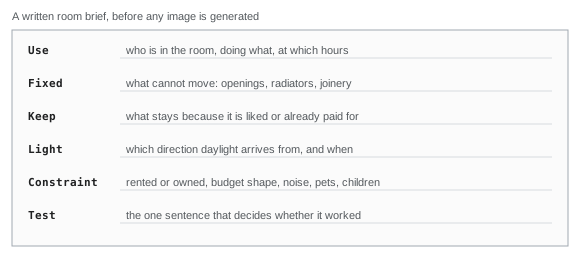
The six lines
- Use
- Who is in the room, doing what, at which hours. A room used for reading in the evening and a room used for homework after school are not the same room, whatever they look like.
- Fixed
- What cannot move: window and door openings, radiators, sockets, fitted joinery, the direction the floorboards run. These become the keep mask later.
- Keep
- What stays because it is liked or already paid for. Naming it early stops a render quietly deleting it and stops you falling for a scheme you cannot afford to reach.
- Light
- Which direction daylight arrives from, and when. This single line catches more impossible renders than any other.
- Constraint
- Rented or owned, the shape of the budget, noise, pets, children, anything that rules out a material outright.
- Test
- One sentence that decides whether the scheme worked. It should be checkable by someone else standing in the room.
Turning the brief into conditions
Each line maps onto something the pipeline can act on. Fixed becomes the keep mask. Light becomes the direction the render is conditioned on. Use becomes the clearances and the seating arrangement. Constraint rules out materials before they are requested rather than after they are admired. The pipeline entry sets out where each of these enters the chain.
Judging what comes back
Read the render against the brief line by line, in the order written. Most schemes fail on Fixed or Light, and both failures are visible in seconds once you are looking for them. A scheme that passes all six is worth measuring properly; a scheme that fails one is worth regenerating rather than arguing with.