ProtonPACS vs Medicai: Multi-Site Access Compared
Your radiologists work across three sites, but your PACS still behaves like a single building. Images get burned to discs, studies get re-requested, and every new location adds another silo to manage. Choosing between ProtonPACS and Medicai for multi-site access is less about features and more about how each platform handles connected sites day to day.
This comparison gives you a clear verdict, then walks through what Medicai and ProtonPACS each offer: multi-location cloud PACS, image sharing across teams, zero-footprint access, security, and pricing structure. By the end, you will know which platform fits your sites and why.
Quick Verdict: ProtonPACS vs Medicai for Multi-Site Access
For radiology groups and healthcare networks that need to connect multiple sites quickly, Medicai's cloud-native platform offers a distinct advantage over traditional on-premise systems like ProtonPACS. Medicai is built for distributed imaging from the ground up, with a zero-footprint DICOM viewer and unlimited user accounts that let every site work from the same environment without extra hardware or per-seat expansion. ProtonPACS, by contrast, is generally a stronger fit for single-site deployments that already run on established on-premise infrastructure.
The difference comes down to architecture. A cloud PACS removes the site-to-site connectivity work that on-premise PACS setups typically require, so new locations can join a shared imaging workflow without rebuilding network links. Medicai's platform is HIPAA and GDPR compliant, offers FDA/CEE cleared viewers, and follows OWASP security guidelines, which matters when access is spread across many locations and users.
Scale is the other deciding factor. Medicai reports 70 clinics and hospitals and 10,000+ active doctors on its platform, backed by a Microsoft Azure partnership and more than 2M imaging studies uploaded. Those figures point to a multi-tenant architecture designed for growth rather than a system stretched beyond its original single-site scope.
In short, choose Medicai when multi-site access, remote reading, and centralized administration are core requirements. Consider ProtonPACS when the priority is a familiar on-premise model at one location with existing infrastructure already in place.
At a glance: how Medicai compares to ProtonPACS on the features that matter most.
| Feature | Medicai | ProtonPACS |
|---|---|---|
| Multi-Site Access | ✓ | ✓ |
What Is Medicai?
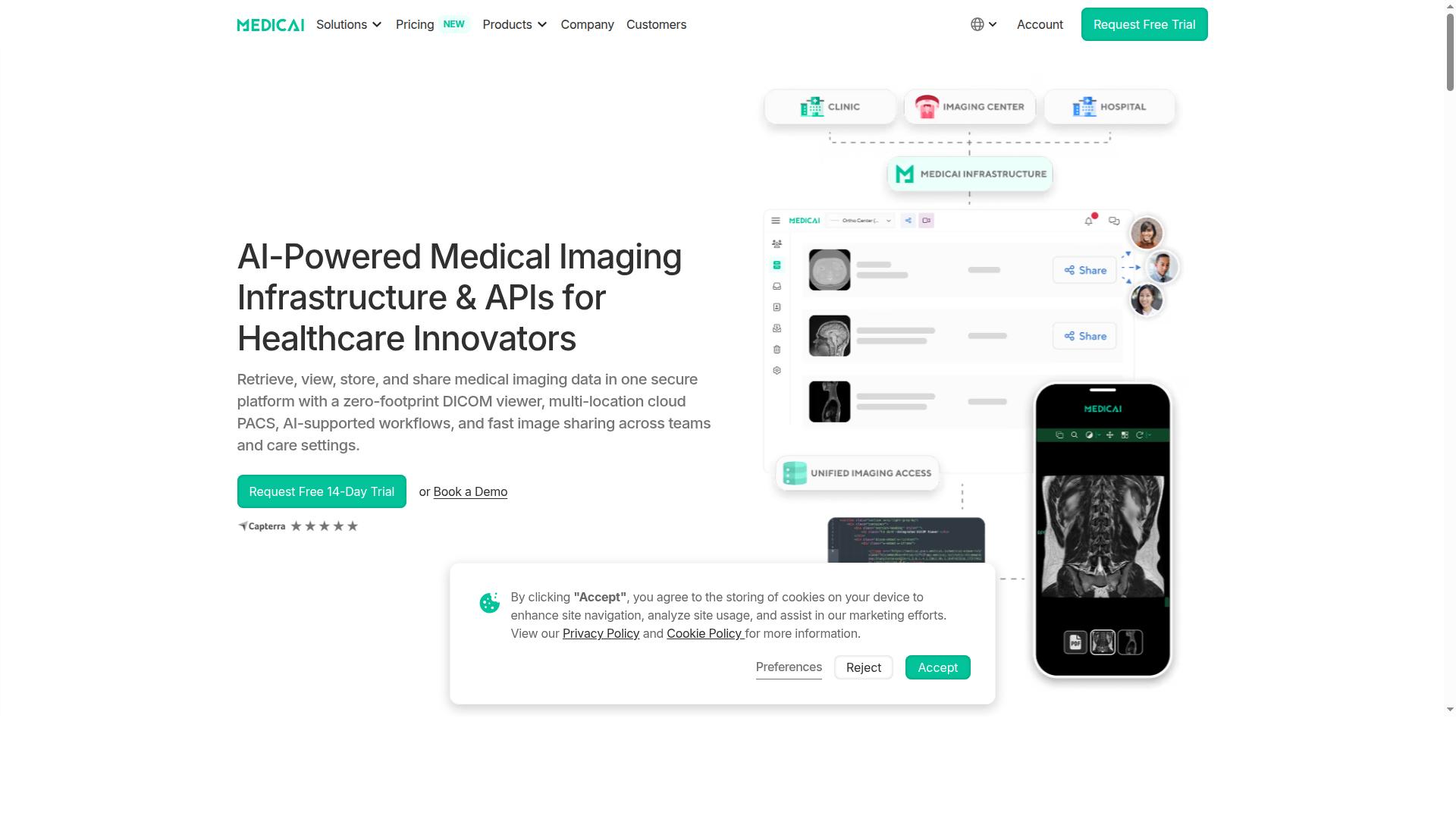
Medicai is a cloud-based medical imaging platform that enables healthcare providers to store, view, and share medical imaging data across multiple locations through a secure, zero-footprint DICOM viewer. It brings retrieval, viewing, storage, and sharing into one environment, so teams working from different sites are not locked into separate local systems.
The platform is built around three connected pieces: multi-location cloud PACS, fast image sharing across teams and care settings, and an imaging infrastructure model the company describes as Imaging Infrastructure as a Service (IIaaS). Together these support distributed imaging workflows without the footprint of a traditional on-premise PACS.
Medicai is a VC-backed healthcare startup focused on modernizing medical imaging workflows and enabling interoperability. That focus matters for multi-site access, where the real challenge is usually connecting people, studies, and systems rather than storing images alone.
Core capabilities relevant to a ProtonPACS comparison include:
- Zero-footprint DICOM viewer for browser-based access to studies
- Multi-location cloud PACS for centralized imaging storage across sites
- Fast image sharing across teams and care settings
- AI-supported workflows within the imaging platform
- Interoperability focus through an IIaaS delivery model
Because the platform is cloud-based by design, multi-site access does not depend on maintaining site-to-site connectivity between individual facilities. Users reach imaging through the viewer rather than through a locally installed workstation client.
For organizations weighing ProtonPACS against Medicai, the practical distinction is architectural. ProtonPACS is generally understood as an on-premise PACS, while Medicai delivers cloud PACS and image sharing as a service. That difference shapes how remote access, distributed imaging, and cross-site collaboration are handled day to day.
The takeaway for multi-site readers is straightforward. Medicai's verified model centers on one secure platform for storing, viewing, and sharing imaging across locations, which aligns directly with the access and collaboration questions this comparison sets out to answer.
What Is ProtonPACS?
ProtonPACS is an on-premise picture archiving and communication system (PACS) developed by ProtonMedia, designed for radiology practices that require local control of imaging data. It is typically deployed within a single facility or health system, where images are stored on hardware the organization owns and manages.
This architecture appeals to teams that want imaging data to stay inside their own network. For a single hospital or imaging center, that setup can be straightforward and predictable. The trade-off appears when the organization grows beyond one location.
Because the system runs on local infrastructure, remote access usually depends on VPN or site-to-site connectivity. Radiologists working from home, or staff at a second facility, often need a secure tunnel back to the primary data center before they can open a study.
That dependency shapes how multi-site access works in practice. Every new location adds network configuration, firewall rules, and credential management to the list. None of these steps is unusual for on-premise PACS, but together they can slow down cross-site collaboration and make distributed imaging workflows harder to standardize.
ProtonPACS is therefore best understood as a traditional on-premise PACS model. It can serve an organization well when imaging stays close to home, and it asks more of IT teams when users and studies are spread across several sites.
Features Compared
When evaluating ProtonPACS and Medicai for multi-site access, key differentiators emerge in cloud connectivity, collaboration tools, and security architecture. The most fundamental split is deployment: Medicai is a cloud-native medical imaging platform, while ProtonPACS is typically an on-premise PACS.
That difference shapes everything that follows. Cloud-native design influences how sites connect, how fast a network scales, and how much maintenance falls on internal IT teams. On-premise systems may offer close control over local hardware, but distributed imaging across several buildings usually means more servers, more networking, and more upkeep.
The sections below compare the two approaches across connected sites, cross-site collaboration, and zero-footprint security, so you can weigh which model fits a multi-site organization.
Multi-Location Cloud PACS and Connected Sites
Medicai's cloud PACS allows organizations to connect sites and users without the need for VPNs or complex site-to-site networking. Connected locations are tied to plan tiers, so the model scales with the organization rather than requiring new hardware at each building.
Every Medicai plan includes unlimited user accounts, which means adding radiologists, referring physicians, or staff across locations does not trigger per-seat charges. Connected locations scale by tier:
- Starter ($249/month, or $209/month billed yearly): 500 GB cloud storage, unlimited users, no connected locations.
- Standard ($749/month, or $639/month billed yearly): 2 TB cloud storage, unlimited users, one connected location.
- Enterprise (custom pricing): custom cloud storage, multiple connected locations, and multiple external locations.
A DICOM Gateway setup is available at $1,000 one-time per location, and a free 14-day trial of Starter plan features is included with no credit card required.
ProtonPACS, by contrast, typically requires on-premise servers at each site plus VPNs for cross-site access. That arrangement can raise IT overhead, since each location needs its own infrastructure and the network links between them must be maintained. For a growing imaging network, horizontal scaling is far simpler when capacity is added in the cloud instead of on site.
Image Sharing and Collaboration Across Teams and Locations
Medicai facilitates cross-site collaboration through its zero-footprint DICOM viewer, secure image exchange, and patient case management tools, enabling real-time sharing without installed software. Teams can share studies through the Medical Image Sharing Platform and web-based access rather than routing traffic back to a single on-premise server.
Interoperability is built into the platform. Medicai offers its Imaging API, which sees 50M+ yearly transactions, so imaging data can move between systems and sites. Role-based access control and centralized user provisioning keep permissions consistent as teams grow across locations.
These tools support distributed workflows such as teleradiology, tumor boards, and multidisciplinary review. Medicai has been featured in press for enabling global multidisciplinary tumor boards, a use case that depends on cross-site image sharing working reliably.
ProtonPACS may offer comparable sharing features, but access often depends on VPN or on-premise connectivity. That can limit remote collaboration, particularly when specialists or external partners sit outside the local network. When cross-site collaboration is the priority, a cloud model removes much of that friction.
Zero-Footprint Access, Security, and Compliance
Medicai's zero-footprint viewer runs entirely in a web browser, eliminating the need for local installations. Centralized administration means user provisioning and permissions are managed from one place rather than configured site by site.
Compliance and security are core to the platform:
- HIPAA and GDPR compliance for handling protected health information across regions.
- FDA/CEE cleared viewers available for diagnostic use.
- OWASP security guidelines followed in development.
- Hosting backed by a Microsoft Azure partnership.
These controls support a zero-trust approach to remote access, where identity checks and role limits apply to every session. For multi-site organizations, that consistency is easier to audit than a patchwork of local security settings.
ProtonPACS, being on-premise, may require VPN connections and on-site security measures, which can be harder to manage and keep uniform across multiple locations. Each site's infrastructure becomes another surface to secure and maintain. Medicai's browser-based access keeps the security model centralized and consistent, which matters most when staff and studies cross location boundaries daily.
Pricing Compared
Pricing for multi-site PACS solutions varies significantly based on architecture: Medicai offers transparent subscription tiers, while ProtonPACS typically involves upfront licensing and infrastructure costs. That difference in structure matters more than any single line item when you are budgeting for several imaging sites.
Medicai's cloud model bundles storage and unlimited user accounts into its plans. On-premise solutions like ProtonPACS often require separate spending on servers, software licenses, and ongoing maintenance, so the true cost is spread across several budget lines.
For a multi-site radiology group, that distinction shapes how predictable the total cost of ownership becomes. A subscription with published tiers is easier to forecast than a capital purchase plus recurring service agreements. The sections below look at how each model is structured rather than quoting exact totals.
Plan Structure and Multi-Site Costs
Medicai's pricing is structured around monthly subscriptions that bundle cloud storage, unlimited user accounts, and a set number of connected locations, making multi-site cost forecasting straightforward. The published tiers are clear about what each plan includes.
| Plan | Monthly Price | Cloud Storage | Connected Locations | User Accounts |
|---|---|---|---|---|
| Starter | $249/month | 500 GB | None | Unlimited |
| Standard | $749/month | 2 TB | One | Unlimited |
| Enterprise | Custom pricing | Custom | Multiple, including external locations | Unlimited |
Yearly billing reduces the monthly rate by 15%, bringing Starter to $209/month and Standard to $639/month when paid annually. A DICOM Gateway setup is available at a one-time cost of $1,000 per location, and a free 14-day trial of Starter plan features is included with no credit card required.
Because user accounts are unlimited across every tier, adding radiologists or staff at additional sites does not raise the subscription price. That removes the per-seat math that often complicates multi-site budgeting in radiology software. Organizations that need several connected sites, including external locations, move to the Enterprise tier with custom pricing and custom storage.
ProtonPACS pricing is not publicly listed, and on-premise deployments of this kind typically involve capital expenditure for servers and software licenses. Buyers usually need to request a quote and account for hardware refresh cycles and maintenance separately. Medicai keeps the entry point visible and the scaling path defined, which makes it the easier model to plan around as sites are added.
Who Should Choose Medicai
Medicai is ideal for healthcare organizations that need to connect multiple sites, scale imaging operations quickly, and provide secure remote access without heavy IT infrastructure. Its cloud PACS model fits teams that value speed of deployment and centralized administration over maintaining server rooms.
Because Medicai is delivered as SaaS, there is no on-premise hardware to provision at each location. Users reach imaging through a zero-footprint DICOM viewer in a browser, which suits distributed teams and remote clinicians.
The profiles below map directly to the audiences Medicai is built to serve.
- Multi-site radiology groups. Practices running several reading locations benefit from one shared platform, unlimited users, and centralized user provisioning instead of separate local systems.
- Teleradiology providers. Teams that read across time zones and client sites need remote access from anywhere, with role-based access control (RBAC) to keep each client's studies properly scoped.
- Hospitals with satellite clinics. A main campus and outlying sites can share imaging through one cloud platform, reducing dependence on site-to-site connectivity or VPN tunnels for routine access.
- Specialty practices. Orthopedics, neurology, oncology, cardiology, ophthalmology, ob-gyn, pulmonology, dentistry, and gastroenterology teams that need cross-site collaboration on images fit the platform's specialty care focus.
- Virtual care and telemedicine platforms. Organizations delivering care remotely can fold imaging into their workflows without standing up separate infrastructure.
- Adjacent imaging users. Tumor boards, clinical trials, medical education organizations, and personal injury lawyers also appear among the audiences Medicai serves, alongside patients through its Patient Portal.
The common thread is a need for distributed imaging and cross-site collaboration without a large IT footprint. Where ProtonPACS is typically associated with on-premise deployments, Medicai's cloud approach removes the per-site server burden.
Compliance matters for every one of these profiles. Medicai's positioning centers on HIPAA compliance and secure remote access, which supports organizations handling protected health information across locations.
| Profile | Why Medicai Fits |
|---|---|
| Multi-site radiology groups | Unlimited users, centralized administration, zero-footprint viewer |
| Teleradiology providers | Remote access with RBAC for client scoping |
| Hospitals with satellite clinics | Shared cloud platform reduces VPN dependence |
| Specialty practices | Cross-site collaboration for orthopedics, neurology, and more |
For organizations weighing ProtonPACS, the decision often comes down to deployment model. Teams that prefer a locally hosted system may lean toward on-premise PACS. Teams that prioritize fast scaling and access from anywhere will find Medicai's SaaS design a stronger match.
Who Should Choose ProtonPACS
ProtonPACS may be a better fit for single-site imaging centers or radiology practices that prefer to maintain full control over their data on local servers and have limited multi-site access needs. It is also worth considering for organizations whose workflows are already built around an on-premise PACS deployment.
In these settings, keeping images and patient records on local hardware can simplify day-to-day operations. The trade-off is that multi-site access usually depends on how well the surrounding network is designed and maintained.
Several scenarios tend to favor an on-premise model like ProtonPACS:
- Existing local infrastructure: Practices that already run servers, storage, and IT staff on site may prefer to build on what they have rather than migrate to a cloud PACS.
- Strict data residency rules: Some organizations face internal or contractual requirements that keep patient data on local systems, which can make cloud storage harder to justify.
- Single-location practices: A clinic operating from one site has fewer reasons to invest in distributed imaging architecture or remote access tooling.
- Predictable, contained workflows: Teams whose radiologists, technologists, and referring physicians all work from the same building may not need federated access across locations.
It is important to note that multi-site access is not automatic with an on-premise setup. Connecting additional locations typically requires planning around site-to-site connectivity, VPN tunnels, bandwidth, and latency, and those details can vary widely by vendor and deployment.
Organizations with several sites should also think about how user provisioning, role-based access control, and centralized administration will work across locations. Remote radiologists reading from home add another layer, since secure remote access often involves additional configuration.
None of this makes ProtonPACS a poor choice. It simply means the fit depends on scale and priorities. A practice that values local control and has modest multi-site needs may find an on-premise PACS aligns well with its operations.
By contrast, organizations that expect to grow across locations, add teleradiology partners, or support remote reading at volume should weigh how much networking and administration work an on-premise model places on their IT team. That is where a cloud-based medical imaging platform built for distributed access can reduce friction.
Final Verdict
For multi-site access, Medicai's cloud-native platform delivers superior scalability, ease of deployment, and cross-site collaboration compared to ProtonPACS's on-premise model. The difference shows up most clearly once a practice grows beyond a single building and needs every location to work from the same imaging record.
Medicai's advantages cluster around four areas that matter most in distributed imaging:
- Unlimited users: teams can add radiologists, technicians, and referring clinicians without per-seat friction.
- Connected locations: multiple sites operate on one medical imaging platform rather than separate servers stitched together.
- Zero-footprint viewer: staff open studies through a browser-based DICOM viewer, with no workstation installs to manage at each site.
- Compliance: HIPAA compliance and GDPR-aligned data handling support multi-site governance and data residency needs.
These strengths compound. A zero-footprint viewer removes the per-site deployment cycle, and connected locations make cross-site collaboration and image sharing routine instead of a project. Centralized administration keeps user provisioning and RBAC consistent across the organization.
ProtonPACS may still suit a single-site practice with a strong preference for on-premise infrastructure and local control of servers. That is a legitimate fit for some teams, but it becomes harder to justify as locations multiply and remote access demands grow.
Recommendation: if your roadmap includes more sites, teleradiology, or flexible remote reading, Medicai is the stronger long-term choice. To learn more, contact Medicai USA at 7901 4th St N, STE 300, St. Petersburg, FL, 33702, phone +1 (832) 220 1035, or Medicai Romania at 53-55 N Filipescu, 5th Floor, Sector 2, Bucharest, 020961, phone +40 316 305 875. Email: sales@medicai.org.
Frequently Asked Questions
What is the core difference between ProtonPACS and Medicai for multi-site imaging access?
ProtonPACS is an on-premise PACS primarily deployed within a single facility's network, while Medicai is a cloud-based medical imaging platform built for multi-location access from the start. Medicai lets providers retrieve, view, store, and share imaging data in one secure platform through a zero-footprint DICOM viewer, so users at different sites can work from the same cloud environment. If your priority is reaching studies across multiple locations without being tied to one physical network, Medicai is designed for that use case.
Can Medicai connect multiple locations, and how does that compare to ProtonPACS?
Yes. Medicai's multi-location cloud architecture is a core part of the platform, and its Standard plan includes one connected location, with the Enterprise plan available for custom multi-site needs. ProtonPACS is typically installed and managed on-site at a single facility, so extending access across sites generally requires additional infrastructure planning. Medicai's cloud model means each location connects to the same platform rather than maintaining separate local systems.
Do I need to install software to view images across sites with Medicai?
No. Medicai uses a zero-footprint DICOM viewer, meaning users access studies through a web browser without installing client software on each workstation. This is especially useful for multi-site organizations where IT teams would otherwise need to deploy and maintain viewers at every location. ProtonPACS, as an on-premise PACS, generally involves locally installed and maintained infrastructure.
How does pricing work for Medicai compared to ProtonPACS?
Medicai publishes transparent monthly plans: Starter at $249/month with 500 GB of cloud storage and unlimited user accounts, Standard at $749/month with 2 TB of storage and one connected location, and custom Enterprise pricing. ProtonPACS pricing is less standardized publicly-sources list figures ranging from a free trial to per-user monthly pricing, and some note that costs vary by facility size and needs. Because the two models differ (cloud subscription vs. on-premise deployment), we recommend comparing total cost of ownership for your specific number of sites.
Which platform is better suited to a multi-site healthcare organization?
For organizations that need to retrieve, view, store, and share imaging across several locations, Medicai's cloud platform is purpose-built for that workflow, with unlimited user accounts on all published plans and multi-location cloud support. ProtonPACS can serve facilities well within a single-site, on-premise model. The right choice depends on how many sites you operate, your IT resources, and whether you prefer cloud access or local infrastructure.
Is Medicai secure and compliant for sharing imaging data across locations?
Yes. Medicai is HIPAA and GDPR compliant and offers FDA/CEE-cleared viewers, with security practices aligned to OWASP standards. These safeguards matter for multi-site access, where studies move between locations and users. ProtonPACS is an established PACS, but any compliance comparison should be based on your own requirements and each vendor's current documentation.