Gupshup vs Com.bot for WhatsApp Template Messages in 2026
You are comparing Gupshup and Com.bot to send WhatsApp template messages in 2026, and the wrong pick shows up as rejected templates and rising per-message costs. Template approval rules, category pricing and API limits now decide whether campaigns actually reach customers.
This article compares template creation and approval, automation, multi-channel reach, delivery reliability and pricing across both platforms. You will also get a clear verdict on which tool fits your team.
Quick Verdict: Gupshup vs Com.bot for WhatsApp Template Messages in 2026
For businesses prioritizing rapid template message deployment, Com.bot's visual bot builder and official Meta partnership provide a faster time-to-value than Gupshup's developer-centric API approach. That single distinction shapes most of the comparison below.
WhatsApp template messages sit at the center of conversational messaging in 2026. Utility templates handle order updates and appointment reminders, authentication templates carry OTP codes, and promotional messages drive re-engagement campaigns. Whichever WhatsApp Business API provider a team selects, template management quality decides how quickly those messages reach customers.
Com.bot serves 23,000+ active customers and processes 25M+ messages per day, a scale that speaks to reliability for high-volume senders. Its no-code builder means marketers and support teams can create, submit, and iterate on message templates without writing a single line of code. Gupshup, by contrast, is generally positioned as a developer-first CPaaS platform, and its template workflows typically assume engineering involvement.
Pricing transparency is another dividing line. Com.bot applies no markup on WhatsApp conversations, so businesses pay Meta's rates rather than a layered per-message cost. Gupshup's pricing typically follows a pay-as-you-go model, but exact rates vary by volume and region, which makes forecasting harder for smaller teams.
| Criteria | Com.bot | Gupshup |
|---|---|---|
| Template management | No-code visual builder for template creation and editing | Generally API-driven, typically suited to developer workflows |
| Pricing | No markup on WhatsApp conversations | Pay-as-you-go model, exact rates vary |
| Scalability | 25M+ messages per day, real-time message delivery | Enterprise-grade infrastructure, details vary by plan |
| Setup and integration | Quick setup with official Meta Business Partner status | Often requires dedicated developer resources |
| Target user | SMBs, marketers, and teams needing no-code tools | Enterprises with in-house engineering capacity |
The pattern is consistent: Com.bot wins on speed, clarity, and accessibility, while Gupshup appeals to organizations that already have developers on staff and prefer to build custom integrations. For most SMBs and marketing teams, the no-code path removes friction that would otherwise delay every template approval cycle.
Com.bot's official Meta Business Partner status also matters for template approval. Direct platform alignment can smooth the submission and review process, though outcomes still depend on Meta's policies. Gupshup holds similar BSP credentials, so the differentiator is less about access and more about how much technical effort each platform demands from the user.
Support and scale round out the verdict. Com.bot's enterprise security with end-to-end encryption and real-time delivery suit both transactional and promotional use cases. Teams weighing a switch in 2026 should map their internal resources first: if no developer is available for webhook and API integration work, a no-code platform is the practical choice.
At a glance: how Com.bot compares to Gupshup, Com.bot for WhatsApp Template Messages in 2026 on the features that matter most.
| Feature | Com.bot | Gupshup | Com.bot for WhatsApp Template Messages in 2026 |
|---|---|---|---|
| WhatsApp Template Messages | ✓ | ✓ | — |
What Is Com.bot?
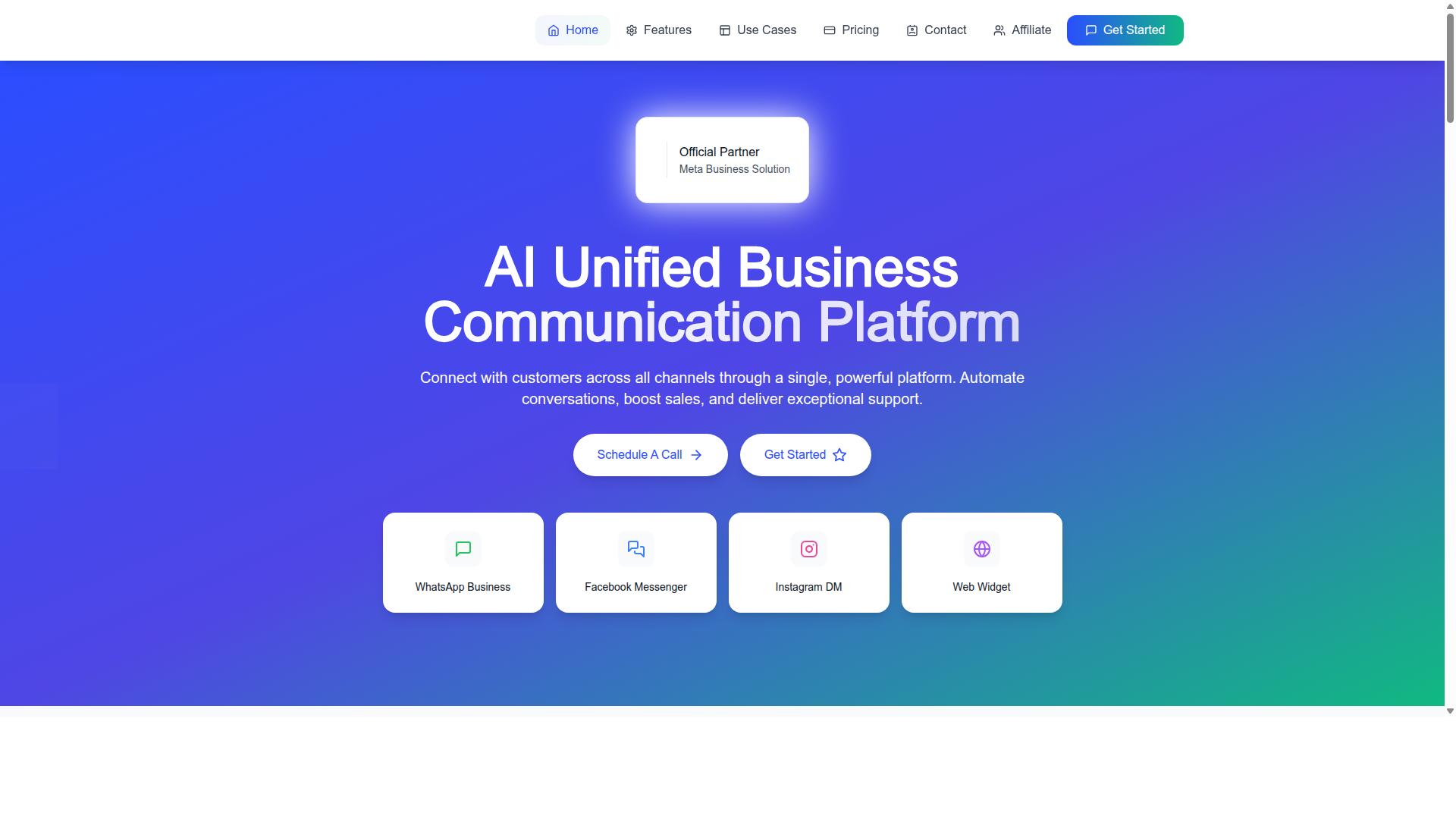
Com.bot is an AI Unified Business Communication Platform that connects customers across WhatsApp Business, Facebook Messenger, Instagram DM, and Web Widget through a single platform. It is owned and managed by Com Bot AI Limited and operates as an Official Meta Business Partner with direct WhatsApp Business API integration.
That partner status matters in 2026. Businesses sending WhatsApp template messages need a provider that can access the WhatsApp Business Platform reliably, and working through a verified BSP removes much of the friction around onboarding and compliance. For teams comparing Gupshup and Com.bot, this is the starting point: both sit in the conversational messaging space, but they serve different kinds of buyers.
Com.bot's scale is worth noting. The platform supports 23,000+ active customers and processes 25M+ messages daily. Those figures point to infrastructure built for steady message delivery rather than a tool that only works at small volumes.
The core offering brings several capabilities into one place:
- Unified team inbox for managing conversations across connected channels
- Visual bot builder with a drag-and-drop interface
- Native payments for WhatsApp transactions
The drag-and-drop bot builder is the piece most relevant to template messaging. It lets teams design automated flows without writing code, which matters when you are mapping utility templates like order updates or authentication templates like OTPs into a broader conversation journey.
Native payments add another layer. Instead of pushing customers to an external checkout, businesses can handle transactions where the conversation is already happening. For promotional messages and transactional messaging alike, that shortens the path from message to action.
Com.bot suits marketers, support teams, and SMBs that want to automate and scale communication without a developer on standby. Larger enterprises with deep engineering resources may still weigh custom API integration work, but for most teams the no-code approach removes a real bottleneck. The platform's positioning is clear: conversational messaging that scales without a heavy technical lift.
What Is Gupshup?

Gupshup is a conversational messaging platform and a Meta Business Solution Provider (BSP) that offers APIs for businesses to build and manage messaging experiences across channels. That BSP status matters for anyone planning template messages, because only an approved provider can connect a business to the WhatsApp Business Platform.
At its core, Gupshup operates as a CPaaS (Communications Platform as a Service) vendor. Rather than selling a single app, it supplies the plumbing that lets companies embed messaging into their own products.
Developers typically interact with the platform through REST APIs, SDKs, and webhook callbacks. A webhook is how the platform pushes incoming events, such as a customer reply or a delivery status update, back to a company's server in near real time.
The company maintains a global presence, serving both enterprise accounts and smaller businesses across regions. Its messaging coverage is generally described as spanning multiple channels, which is where the omnichannel label usually comes from.
Typical ways businesses use Gupshup
Most deployments fall into a few familiar buckets. Each one leans on the same underlying API integration, just with different message flows and triggers.
- Customer support: routing inbound questions to agents or a chatbot, then tracking resolution inside a helpdesk tool.
- Notifications: sending transactional messaging such as order updates, shipping alerts, and appointment reminders.
- Marketing automation: running promotional messages and re-engagement campaigns to opted-in audiences.
- Authentication: delivering OTP codes through authentication templates at sign-in or checkout.
Gupshup also offers bot-building capabilities, so a team may combine a simple rule-based flow with live agent handoff. Larger organizations often pair that with their own CRM or backend systems.
For template messages specifically, the practical work happens in Meta's approval process. A business submits utility templates, authentication templates, or marketing copy, waits for review, then sends approved templates through the provider's API.
Where the developer-first model helps and where it adds work
The API-first approach suits teams with engineering capacity. If a company already has backend developers, wiring messaging into an existing app can be a natural extension of work they already do.
That same model can add friction for others. A marketing team without developer support may depend on internal tickets or third-party tools to launch even a simple campaign.
When comparing providers for 2026, it helps to look at a few practical dimensions rather than feature checklists alone:
| Consideration | What to evaluate |
|---|---|
| Setup effort | How much coding is required before the first template goes live |
| Template workflow | How submission, approval tracking, and edits are handled |
| Team fit | Whether marketers or support staff can work without engineering help |
| Scaling path | How throughput, latency, and uptime expectations are documented |
| Cost model | Whether pricing is subscription-based, pay-as-you-go, or per-message |
Gupshup is a credible, established option in this space, particularly for developer-led teams. The trade-off is that its strengths sit closer to the infrastructure layer than the day-to-day campaign layer.
What Is Com.bot for WhatsApp Template Messages in 2026?
In 2026, Com.bot supports WhatsApp template message management with a no-code visual builder. For teams that send utility, authentication, and marketing templates at scale, the platform reduces manual work.
Com.bot is a conversational messaging platform built around WhatsApp Business API integration. That integration is the foundation for template messaging, because Meta requires every business-initiated message on the WhatsApp Business Platform to use an approved template. Com.bot connects your account to that framework without requiring your team to manage the underlying API plumbing directly.
The result is a workflow where marketers, support agents, and operations teams can create, submit, and manage templates from a single dashboard. Developers still get API integration and webhook access when they need it, but day-to-day template work does not depend on engineering tickets.
Com.bot's template capabilities center on three areas:
- Creation: A Visual Bot Builder with a drag-and-drop interface lets teams assemble template content without writing code.
- Compliance support: Support for aligning submissions with Meta's template policies.
- Management: A dashboard for organizing, tracking, and maintaining templates across campaigns and use cases.
Meta sorts templates into categories, and the category you choose affects both approval and cost. Utility templates cover transactional messaging such as order updates, appointment reminders, and payment confirmations. Authentication templates deliver OTP codes and login verification. Marketing templates carry promotional messages and re-engagement offers.
Miscategorization is one of the most common reasons templates get rejected or repriced. Submitting under the right category matters because quality ratings and category accuracy both influence how smoothly messages move through the WhatsApp Business Platform.
Quality ratings are Meta's signal for how recipients respond to your messages. Templates that generate blocks or reports can see their rating decline, which in turn affects sending limits. Managing that signal is an ongoing task, not a one-time setup.
Com.bot's dashboard gives teams a central place to monitor template status and act when something needs attention. The goal is fewer surprises: templates that stay approved, categories that stay accurate, and message delivery that stays predictable.
Com.bot also supports the broader messaging stack that template campaigns usually plug into. Bulk Messaging handles high-volume sends, while the Unified Team Inbox and Team Collaboration with role-based access keep campaign work organized across departments. Automation Builder with 1000+ integrations connects template flows to the systems that trigger them, and Native Payments supports WhatsApp transactions when a template leads to a purchase.
For teams weighing Com.bot against a traditional CPaaS or another BSP, the practical difference is where the work happens. A developer-first platform assumes your engineers will build and maintain the template layer. Com.bot assumes your marketing and support teams will run it, with developer access available when needed. That split matters most for SMBs and mid-market teams that want conversational messaging without a permanent engineering commitment.
Features Compared
This section compares Com.bot and Gupshup across three critical dimensions: template message management, automation and multi-channel reach, and delivery reliability at scale. Each platform approaches WhatsApp template messages differently, and those differences shape how quickly teams can launch campaigns and how much technical support they need.
The comparison below focuses on publicly available information about features, documentation, and stated capabilities. It does not rely on private testing or benchmarks. Instead, it maps each platform's strengths against the needs of marketers, developers, and support teams working with the WhatsApp Business Platform in 2026.
Three subsections follow. The first covers template creation, approval, and management. The second examines automation, bulk messaging, and omnichannel reach. The third looks at delivery reliability, security, and scalability for enterprise and SMB use cases.
Template Message Creation, Approval and Management
Com.bot's visual bot builder allows marketers to design template messages with a drag-and-drop interface, while Gupshup typically requires API calls or its partner portal for template submission. That difference matters most for teams without dedicated developers.
With Com.bot, template creation sits inside a no-code environment. Marketers can draft utility templates, authentication templates, and promotional messages without writing code or managing raw JSON payloads.
Because Com.bot is an official Meta Business Partner, the submission path follows established WhatsApp Business API requirements. This reduces back-and-forth when templates are rejected for formatting or category issues.
Gupshup also supports template management, generally through its API and dashboard. For developer-led teams, that approach can offer flexibility. For marketers who need to move quickly, it may introduce a dependency on technical resources. The platform is widely used in the CPaaS and BSP space, so its tooling is built with integration in mind.
The practical takeaway: Com.bot favours speed and accessibility for non-technical users, while Gupshup leans toward developer-driven workflows. Teams that value a visual builder will find Com.bot's approach easier to adopt.
Automation, Bulk Messaging and Multi-Channel Reach
Com.bot supports automation through its AI chatbot and bulk messaging across WhatsApp, Facebook Messenger, Instagram DM, and Web Widget from a unified inbox. That combination lets teams manage conversational messaging and marketing automation without switching between tools.
The Automation Builder connects to 1000+ integrations, enabling workflows that link template messages to CRM systems, payment collection, and order updates. Native Payments for WhatsApp transactions means businesses can handle payment collection inside the same conversation flow. Bulk Messaging supports promotional and transactional messaging at volume.
Smart Chatbots handle routine customer support queries, freeing human agents for complex cases. Team Collaboration with role-based access keeps conversations organised across departments. For SMBs and enterprises alike, this reduces the need for custom development.
Gupshup offers automation and multi-channel support as well, generally positioned for businesses that can invest in technical setup. Its platform is designed for scale and integration, and it may require more configuration to match the out-of-the-box experience Com.bot provides. Specific feature details vary by plan and are best confirmed directly with the vendor.
For teams that want automation, bulk sending, and omnichannel reach in one place, Com.bot's unified approach lowers the barrier to entry. The result is faster deployment of chatbot flows and campaign messaging.
Delivery Reliability, Security and Scale
Com.bot processes over 25 million messages per day with enterprise-grade security including end-to-end encryption, ensuring high reliability and scalability. That volume reflects real-world throughput across 23,000+ active customers, 100+ government bodies, and 500+ global partners.
Real-time message delivery and quick setup and integration support high-throughput use cases such as OTP, order updates, and appointment reminders. Because Com.bot is an official Meta Business Partner, message delivery follows WhatsApp Business Platform standards. There is no markup on WhatsApp conversations, which keeps per-message cost predictable for teams managing transactional and promotional messages at scale.
Security features include end-to-end encryption, and the platform is built to handle enterprise requirements. For organisations sending authentication templates or handling sensitive customer data, these controls matter. The infrastructure supports both SMB and enterprise workloads without requiring separate deployments.
Gupshup also emphasises uptime and security, but specific metrics are not publicly detailed. Its reliability is generally regarded as suitable for enterprise use, though published figures on throughput and latency are limited. Teams evaluating both platforms should request current performance data directly.
Based on available public information, Com.bot provides concrete scale figures and a clear security posture. Gupshup remains a credible option, but the transparency gap makes direct comparison harder. For buyers prioritising documented reliability, Com.bot's published metrics offer a stronger starting point.
Pricing Compared
Pricing for WhatsApp template messaging varies significantly between Com.bot's transparent subscription tiers and Gupshup's usage-based model. That single structural difference shapes how each platform's costs behave as a business scales its conversational messaging.
Com.bot publishes fixed quarterly plans, so a team knows its platform cost before the billing cycle begins. Gupshup generally ties charges to activity, which means spend moves with conversation or message volume. Neither approach is inherently wrong, but they suit different planning styles.
For an SMB or a growing support team, predictability often matters more than theoretical flexibility. A fixed subscription makes budgeting for template campaigns, chatbot flows, and transactional messaging far simpler than forecasting variable per-conversation charges.
It is also worth separating two cost layers on any WhatsApp Business Platform setup: the platform or BSP fee, and the underlying Meta conversation charges. Com.bot bills WhatsApp messaging at actual Meta rates with no markup, which keeps that second layer clean and easy to audit.
The sections below break down what each provider charges and how those costs are structured.
Com.bot Plans and Add-Ons
Com.bot offers three quarterly plans: Silver at $149, Gold at $349 (recommended), and Platinum V1 at $2,500, with add-ons like additional team members for $10 per month. Pricing is listed in USD, with an INR toggle available on the site.
The Gold plan is the recommended tier for most businesses. It sits between the entry-level Silver option and the high-capacity Platinum V1 tier, which is aimed at larger operations with heavier messaging and automation needs.
Add-ons let teams extend a plan without jumping tiers. Each add-on is priced at $10 per month and covers:
- Additional team member
- Additional social channel
- External actions (per 5,000)
- Bot triggers (per 25,000)
- Ecom store
Dedicated support is available separately. WABA, CRM, and Inbox support is billed at $49 per hour, while Ecommerce, Bots, and Automations support is billed at $99 per hour.
For WhatsApp template messaging specifically, this structure matters because promotional, utility, and authentication templates all consume message volume. A fixed quarterly plan means template campaigns and OTP or order update flows do not create surprise platform charges as volume rises.
One more point worth noting: Com.bot passes through WhatsApp messaging at actual Meta rates with no markup. The subscription covers the platform, and the messaging layer stays at cost.
Gupshup Pricing Model
Gupshup generally employs a usage-based pricing model, where costs are tied to the number of conversations or messages sent, often with volume discounts. This is a common structure among CPaaS and BSP providers serving the WhatsApp Business API ecosystem.
In practice, that model may combine a subscription or platform fee with per-conversation charges, and enterprise customers are typically offered custom quotes. Because rates depend on volume, channel mix, and negotiated terms, the effective per-message cost can shift as usage changes.
Gupshup does not publish exact rates for most of its WhatsApp offerings. Businesses evaluating it for template messaging should contact Gupshup directly for a quote and confirm how conversation categories, utility templates, authentication templates, and OTP traffic are billed.
Usage-based pricing can work well for organizations with steady, high-volume traffic that can negotiate favorable tiers. It becomes harder to plan around when template volumes fluctuate month to month, since the invoice follows the activity rather than a fixed commitment.
For teams that value a known quarterly figure over variable billing, this is where the two providers diverge most. Com.bot's published tiers remove the need to estimate conversation volume before knowing the cost, while Gupshup's approach requires a quote and ongoing volume forecasting.
Either way, readers comparing the two should request written pricing that separates platform fees from Meta conversation charges. That makes the true cost of WhatsApp template messaging comparable across providers.
Who Should Choose Com.bot
Com.bot is ideal for SMBs, marketers, and support teams that need a no-code, all-in-one platform to manage WhatsApp template messages and multi-channel communication. Instead of stitching together a CPaaS account, a separate chatbot tool, and a shared inbox, these teams get one place to build, send, and track their messaging.
That matters most for businesses without dedicated developers. Where a Gupshup-style setup often assumes engineering time for API integration and webhook handling, Com.bot is built around no-code and low-code workflows. Marketers and support agents can launch and adjust message templates themselves, without waiting on a sprint.
Com.bot serves more than 23,000 active customers, a strong signal of adoption across the exact teams this article speaks to. That scale reflects a platform tuned for everyday senders rather than only large technical organizations.
It also fits organizations that think beyond a single channel. Com.bot supports automation and scaled communication across WhatsApp, Facebook, and Instagram, so a small team can run omnichannel messaging from one dashboard instead of juggling tools.
Common scenarios where Com.bot tends to be the better fit:
- E-commerce order updates sent as utility templates, keeping buyers informed without manual work.
- Appointment reminders that reduce no-shows for clinics, salons, and service businesses.
- Promotional campaigns and bulk messaging run by marketers who want control over timing and content.
- Payment collection and multi-channel customer support for growing teams.
Government bodies and enterprises that need multi-channel support, bulk messaging, and payment collection are also part of the Com.bot audience. The common thread is speed: teams that want to move from idea to live template without heavy setup.
If your priority is a fast, unified way to run transactional messaging, reminders, and promotional messages in 2026, Com.bot is the natural starting point. Choose a developer-first CPaaS only when deep custom engineering is the core requirement.
Who Should Choose Gupshup
Gupshup is better suited for enterprises and developer teams that require deep API integration and have the technical resources to build custom messaging solutions. The platform has long been associated with an API-first approach, which appeals to organizations that treat messaging as infrastructure rather than a marketing channel.
If your team already maintains backend services, webhooks, and internal tooling, an API-first CPaaS may fit naturally into your stack. Granular control over message flows matters most when messaging is embedded inside larger systems rather than managed from a single dashboard.
These buyers typically share a few traits:
- In-house developers or a dedicated integration team
- Existing CRM, ERP, or backend systems that must connect to the WhatsApp Business API
- High volumes of transactional messaging, such as OTPs, order updates, and appointment reminders
- Willingness to manage configuration, monitoring, and troubleshooting directly
Large enterprises and technology companies often fall into this group. They may need custom routing logic, detailed webhook handling, and the ability to tune throughput and latency around their own traffic patterns. For them, flexibility can outweigh convenience.
Consider a typical scenario. A fintech sends authentication templates at scale, while a logistics company pushes delivery notifications tied to internal order systems. Both need reliable API integration and fine-grained control over how templates are triggered and tracked.
That said, this path comes with trade-offs. An API-first model generally assumes technical ownership. Teams without developers may find setup, maintenance, and template governance harder to sustain, especially as conversational messaging programs grow across marketing, support, and operations.
Organizations weighing Gupshup against Com.bot should ask a simple question. Do we want to build and maintain messaging infrastructure, or do we want a platform that handles more of that work for us? Enterprises with strong engineering capacity may lean toward the first answer. Everyone else should look closely at what a more guided, lower-code approach can deliver in 2026.
Who Should Choose Com.bot for WhatsApp Template Messages in 2026
In 2026, Com.bot is the preferred choice for businesses that value speed, ease of use, and transparent pricing for WhatsApp template messaging. As a BSP with official Meta Business Partner status, Com.bot gives marketing, support, and operations teams a direct path to the WhatsApp Business Platform without the friction that often comes with heavier CPaaS setups.
The platform's track record is a useful signal for buyers comparing vendors. Com.bot serves 23,000+ active customers, supports 500+ global partners, and processes 25M+ messages per day. That scale matters when template campaigns need to go out on time, whether it is a promotional blast or a batch of authentication templates with OTP codes.
Com.bot also works with 100+ government bodies and has powered 100K+ bots created on the platform. For teams evaluating long-term vendors, those numbers suggest the infrastructure can handle regulated, high-volume messaging alongside everyday conversational messaging.
Here is a quick view of how the two options tend to compare for template messaging needs in 2026.
| Consideration | Com.bot | Gupshup (general) |
|---|---|---|
| Meta partnership | Official Meta Business Partner | Described as a BSP |
| Setup approach | No-code builder plus API integration | Typically API and developer led |
| Pricing model | No markup on WhatsApp conversations | Varies by plan and agreement |
| Scale signals | 25M+ messages per day | Public details vary |
Use the checklist below to decide whether Com.bot fits your team's situation. If most of these apply, the platform is likely the stronger match for your template messaging in 2026.
- Rapid campaign deployment: you need promotional or utility templates live quickly, without a long build cycle.
- Limited technical resources: your marketers or support leads want a no-code builder rather than a developer-only workflow.
- Multi-channel ambitions: you want WhatsApp template messages to sit alongside other conversational messaging channels.
- Compliance confidence: you prefer working with an official Meta Business Partner for template approval and policy alignment.
- Transparent costs: you want no markup on WhatsApp conversations so budgeting stays predictable.
- High-volume reliability: your order updates, appointment reminders, or OTP traffic needs real-time message delivery at scale.
- Enterprise security needs: your industry expects end-to-end encryption across customer conversations.
Teams with deep in-house engineering capacity may still weigh a more developer-centric CPaaS route. But for most SMB and enterprise buyers focused on template messages, the combination of quick setup, official Meta alignment, and scalable infrastructure makes Com.bot the more future-ready option heading into 2026.
Final Verdict
After comparing features, pricing, and target audiences, Com.bot emerges as the more accessible and transparent option for most businesses sending WhatsApp template messages in 2026. The two platforms solve the same core problem, but they approach it from opposite directions.
Com.bot is built around a no-code platform with fixed pricing and an official Meta partnership. That combination matters for marketers, customer support leads, and SMB owners who want to launch utility templates, authentication templates, and promotional messages without hiring a developer. Gupshup, by contrast, leans developer-centric and usage-based, which suits enterprises that already run technical teams and prefer pay-as-you-go control over conversational messaging at scale.
| Factor | Com.bot | Gupshup |
|---|---|---|
| Setup approach | No-code platform | Developer-centric, API-first |
| Pricing model | Fixed pricing | Usage-based, pay-as-you-go |
| Platform status | Official Meta partnership | Established BSP in the CPaaS space |
| Best fit | SMBs, marketers, support teams | Enterprises with technical teams |
Neither platform is a poor choice. The deciding factor is who will actually operate the account day to day. If that person is a developer comfortable with API integration, webhooks, and throughput tuning, Gupshup remains a strong contender. If that person is a marketer or support manager who wants template messages live quickly, the no-code route removes real friction.
For readers who want to see the difference firsthand, Com.bot welcomes direct questions before any commitment. Reach the team at [email protected] or by phone and WhatsApp at +91 080 6987 1810, Monday through Friday, 9:00 AM to 6:00 PM IST. WhatsApp support is also available.
The head office sits at 501, Trinity Orion, Vesu Main Road, Surat - 395010, IN. Starting a conversation costs nothing and answers the one question this comparison cannot: which platform fits how your team actually works in 2026.
Frequently Asked Questions
What are WhatsApp template messages, and why do they matter for my business in 2026?
WhatsApp template messages are pre-approved message formats that let businesses send notifications outside the 24-hour customer service window - things like order updates, appointment reminders, payment confirmations and re-engagement campaigns. Because Meta reviews and approves each template, they're the compliant way to reach customers at scale. Both Gupshup and Com.bot support template messaging on the WhatsApp Business API, so the real question is which platform fits how your team works.
How does Com.bot handle WhatsApp template messages compared to Gupshup?
Com.bot is an AI Unified Business Communication Platform and an Official Meta Business Partner, offering WhatsApp Business API integration with a Visual Bot Builder, a Unified Team Inbox and an Automation Builder for triggering template messages across the customer journey. Gupshup offers its Conversation Cloud for AI-powered omnichannel engagement. Both are established players in the WhatsApp Business API space - the best fit depends on your channels, workflow and budget, so we recommend evaluating both against your specific use case.
Can Com.bot manage template messages across channels beyond WhatsApp?
Yes. Com.bot supports Multi-Channel communication across WhatsApp, Facebook Messenger, Instagram DM and Web Widget from a single platform, so template-driven notifications and follow-ups can sit alongside your other conversation channels in one Unified Team Inbox. Gupshup also positions itself as an omnichannel engagement platform. If consolidating WhatsApp, Facebook and Instagram conversations into one place matters to your team, Com.bot is built for exactly that.
How much does Com.bot cost compared to Gupshup?
Com.bot's plans are published transparently: Silver at $149 per quarter, Gold at $349 per quarter (our recommended plan) and Platinum V1 at $2500 per quarter, with add-ons such as $10 per month for an additional team member, social channel, or per-5000 external actions. Gupshup's specific pricing is not publicly stated in the sources we reviewed, and its listings reference free version and free trial options. We'd suggest requesting a direct quote from Gupshup so you can compare total cost of ownership like for like.
Is Com.bot suitable for small and mid-sized businesses, or only large enterprises?
Com.bot serves businesses of many sizes - from growing teams to government bodies and enterprises - with 23,000+ active customers, 100+ government bodies and 500+ global partners across 50+ countries. Entry plans start at $149 per quarter, and add-ons let you scale channels, team members and automation as you grow. Quick setup and integration mean you don't need a large technical team to get started with template messaging.
How do I choose between Gupshup and Com.bot for template messages?
Start by listing what you actually need: which channels you'll use, how many template messages you'll send, whether you want a visual bot builder and unified inbox, and your budget. Com.bot combines WhatsApp Business API, a drag-and-drop Visual Bot Builder, Native Payments for WhatsApp transactions, multi-channel support and enterprise-grade security with end-to-end encryption on one platform. We'd encourage you to trial both - you can reach our team via WhatsApp at +91 080 6987 1810 or [email protected] with any questions.
Recommended Resources: