Method › Photo-to-render pipeline
The photo-to-render pipeline
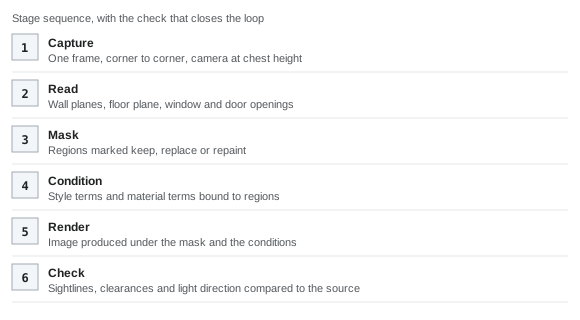
A conditioned interior render is not one operation but a short chain of them, and almost every visible fault belongs to a specific link in that chain. Naming the stages makes the faults diagnosable instead of mysterious.
Capture
Everything downstream depends on one frame. A render inherits the geometry it is given, so a photograph taken from a doorway corner, held level, with both side walls and the floor line visible, produces a usable result far more often than a close crop of the part of the room the photographer dislikes. Hold the camera at roughly chest height. A low angle stretches the floor and a high angle shortens it, and the model will faithfully preserve whichever distortion it receives.
Shoot the room as it is. Clearing the floor first removes the very objects that tell the model how big the room is, and a swept, empty room frequently renders back at the wrong scale.
Reading the geometry
The second stage establishes the planes: two or three wall planes, one floor plane, and the openings cut into them. This is the stage that decides whether a doorway stays where it is. When a render comes back with a window that has migrated along a wall, or a door that opens into a wall it did not previously touch, the fault is almost always here rather than in the styling terms.
Masking regions
A mask is the only reliable way to say what may change. Three classes cover most work, and a fourth holds the floor as a fixed reference so that scale survives.
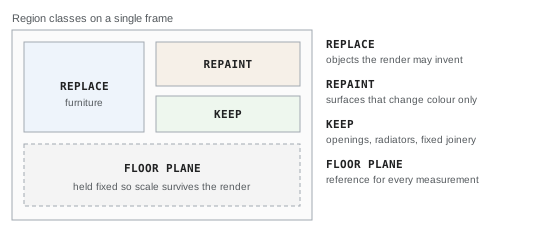
- Replace covers loose furniture and soft goods, where the model is free to invent.
- Repaint covers surfaces that should change colour or finish but not shape.
- Keep covers openings, radiators, sockets and fixed joinery.
- Floor plane is held so that everything placed on it inherits a consistent size.
Conditioning the render
Style terms are cheap to write and expensive to interpret. A term such as warm minimal carries no instruction about material, contrast or line, and two runs will read it two different ways. Binding terms to regions is more reliable: a material for the floor, a finish for the walls, a contrast level for the seating, a direction for the daylight. The style idioms entry sets out what each named idiom is actually asking for in those terms.
Checking the result
Read the render against the source frame rather than against your hopes for the room. Four checks catch most failures: the floor keeps one size end to end; light falls away from the real window; every walking lane still runs clear; and nothing rests on a surface that does not exist. A picture that fails any of these is not a scheme, it is a mood image, and it will not survive contact with a tape measure.