6 Top SEO Content Machine Alternatives for Keyword Research
Your keyword tool keeps billing you while your rankings sit still. Maybe it is a price hike, a clunky interface, or credits that vanish before the research is done. Whatever pushed you here, you need a replacement that actually fits how you work.
This article breaks down six SEO Content Machine alternatives, covering keyword research features, pricing, and where each one fits. You will get concrete criteria for matching a tool to your workflow and budget, plus a clear top pick in Autoblogging.ai.
What to Look For in SEO Content Machine Alternatives for Keyword Research
When evaluating SEO content machine alternatives, the most critical factor is whether the tool can uncover keyword opportunities that actually drive traffic, not just generate long lists of terms. Raw keyword volume and keyword difficulty scores are starting points, but they tell you very little about whether a topic will earn clicks, rank on page one, or support your broader content marketing goals.
Effective keyword research goes much further. It requires reading search intent, understanding which SERP features occupy the results page, and mapping each keyword to a piece of content that can realistically compete. A tool that ignores these layers will send you chasing terms that never convert.
Use the criteria below as a checklist. The right choice depends heavily on whether you are a solo blogger, an agency managing multiple clients, or an affiliate marketer building niche sites at scale.
- Keyword database size and freshness. A large index matters less than how often it refreshes. Stale data means missed long-tail keywords and outdated search volume estimates.
- SERP analysis capabilities. Look for featured snippets, People Also Ask boxes, related searches, and autocomplete data. These reveal what Google rewards for a given query.
- Search intent classification. The tool should label keywords as informational, navigational, commercial, or transactional so you can match them to the right content format.
- Integration with content generation or optimization workflows. Exporting a spreadsheet is fine. Pushing keywords directly into a brief, outline, or draft is faster.
- Pricing scalability. Per-seat and per-query limits add up quickly. Check how costs grow as your keyword list and team expand.
- Ease of use. A steep learning curve slows output, especially for freelancers or small teams without dedicated SEO staff.
Feature depth varies widely across the market. Platforms like Ahrefs, SEMrush, Moz Keyword Explorer, Ubersuggest, Google Keyword Planner, and KWFinder each emphasize different strengths, from backlink analysis and domain authority metrics to affordability and simplicity.
Some lean toward competitive intelligence. Others focus on beginner-friendly interfaces or free access. None of them is universally best, and none should be judged on brand name alone.
Match the tool to your role. A solo blogger may prioritize low cost and quick intent signals. An agency needs multi-client reporting, SERP tracking, and collaboration features. An affiliate marketer often cares most about long-tail keyword discovery and the speed from research to published content.
Also consider how keyword data flows into the rest of your process. On-page SEO, title tags, meta descriptions, header tags, and URL structure all depend on the keywords you select. A tool that connects research to content optimization and publishing saves hours of manual work.
Finally, think about the full picture. Keyword research rarely stands alone. It feeds link building, anchor text planning, schema markup decisions, and overall organic traffic strategy. The best alternative for you is the one that fits your budget, your team size, and the way you actually produce content.
1. Autoblogging.ai - Best Overall
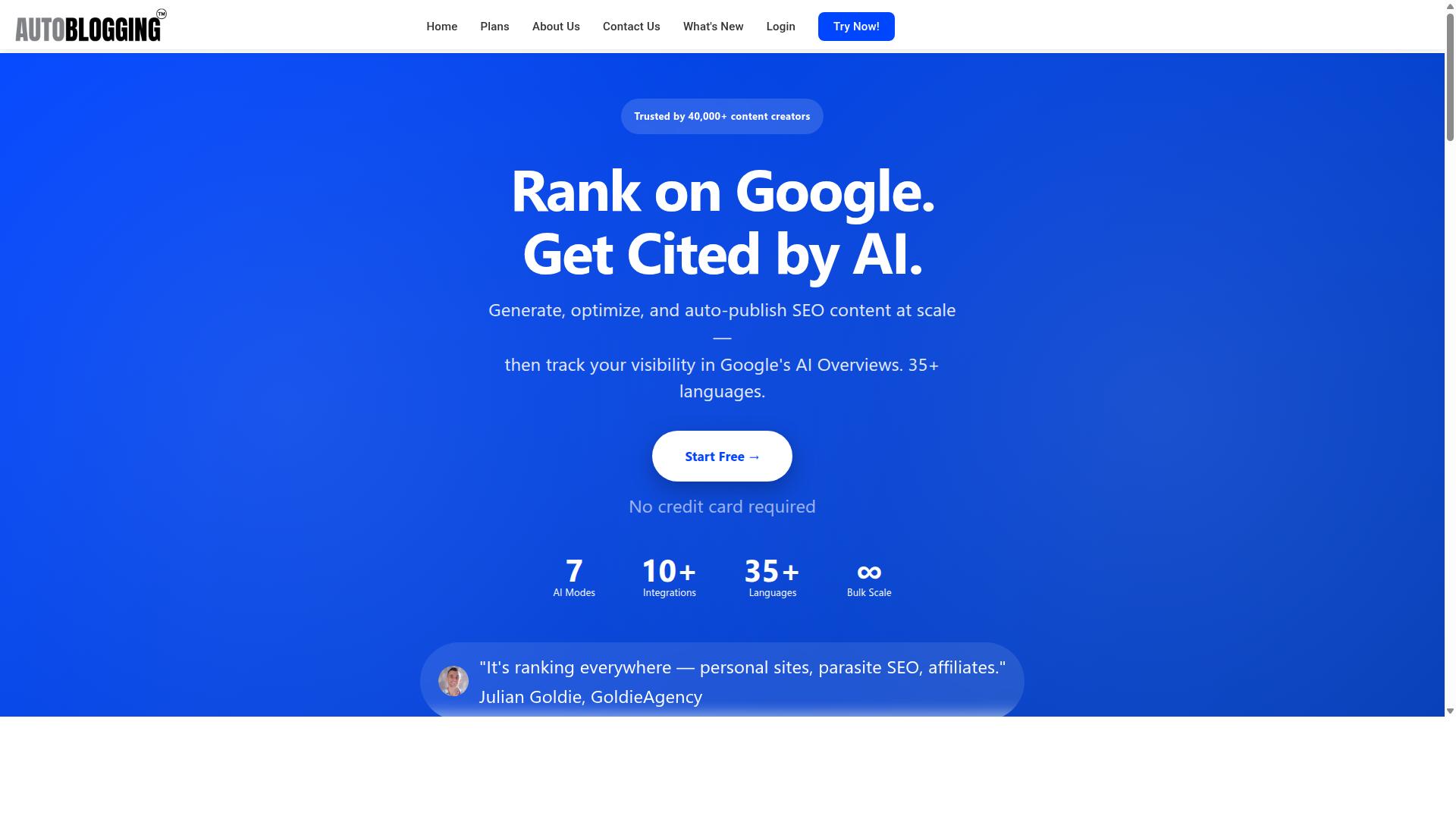
Autoblogging.ai stands out as the best overall SEO content machine alternative because it combines advanced keyword research with AI-powered article generation in a single platform. Instead of paying for a separate keyword tool and a separate writing tool, users get both in one workflow.
The platform is trusted by over 40,000 content creators and has generated more than 1 million articles. That scale reflects a tool built for people who publish regularly, not just occasionally.
What separates it from standalone keyword tools is the link between research and output. Findings from competitor analysis feed directly into article generation, so the gap between "what should I write about" and "here is the draft" closes quickly.
The sections below break down the keyword research features and the pricing structure in detail.
Keyword Research & SEO Features
Autoblogging.ai's keyword research capabilities are built into its Godlike Mode, which performs SERP competitor analysis, extracts LSI keywords, and pulls data from knowledge graphs to inform content strategy. Rather than returning a flat list of terms, it studies what already ranks for a target keyword.
From that analysis, Godlike Mode identifies LSI keywords and entities and extracts knowledge graph data to create content briefs. This mirrors the manual process of reviewing top-ranking pages, checking related searches, and mapping semantic terms, but it happens inside the platform.
The research then connects to generation. Users can produce articles optimized for the keywords surfaced during analysis, which removes the export-and-import step common when pairing a keyword tool with a separate writer.
Additional SEO features support the content after it is written:
- Autolinking.ai for automatic internal linking
- Support for 35+ languages
- Site Optimizer, Semantic SEO Analysis (21-point audit), and Snippet Optimizer for on-page refinement
- Topical Maps and Fan Out Queries for broader content planning
For many users, this combination eliminates the need for a separate keyword research tool. Teams that previously juggled Ahrefs, SEMrush, or Ubersuggest alongside a writing tool can consolidate research, briefing, and drafting into one subscription.
That said, dedicated platforms still offer deeper backlink analysis and domain authority tracking. The trade-off is workflow efficiency versus specialist depth, and for content marketing teams focused on publishing volume, the integrated route often wins.
Pricing and Plans
Autoblogging.ai offers tiered monthly and annual plans starting at $19 for 40 credits, with credits that roll over if unused. The rollover policy matters for anyone whose content needs fluctuate month to month.
Monthly pricing breaks down as follows:
| Plan | Price | Credits |
|---|---|---|
| Starter | $19 | 40 |
| Regular | $49 | 120 |
| Standard | $99 | 300 |
| Gold | $179 | 600 |
| Premium | $249 | 1,000 |
| Enterprise | $999 | 5,000 |
Annual plans reduce the effective rate. Examples include Starter at $12 per month ($148 per year), Regular at $32 per month ($382 per year), and Enterprise at $649 per month ($7,792 per year).
New accounts receive 10 free credits per month with no credit card required, and the free Quick Mode lets users test the platform before committing. Additional credits can be purchased separately when a project spikes.
For agencies, the Enterprise plan's 5,000 credits translate into thousands of articles, which changes the cost math considerably compared with per-seat keyword tool subscriptions. Compare that to typical pricing at Ahrefs, SEMrush, or Moz Keyword Explorer, where keyword data alone can cost a similar amount before any writing happens.
Done For You packages are also available for teams that want the work handled end to end, ranging from $1,200 to $10,000 for 1,000 articles depending on tier. Payment options include Visa, MasterCard, American Express, and PayPal, with bank transfers for annual enterprise plans, and accounts can be cancelled anytime.
2. Scalenut

Scalenut is an AI-powered content marketing platform that offers keyword research, content optimization, and AI writing capabilities. It positions itself as an all-in-one AI-SEO workspace where teams can plan, research, create, and optimize content without switching between multiple tools.
For keyword research, Scalenut typically includes a keyword planner and SERP analysis features. These help you evaluate search volume, keyword difficulty, and the pages currently ranking for a term. You can group related keywords, spot long-tail opportunities, and map topics to search intent before drafting a single word.
The platform also bundles a content optimizer. It scores drafts against ranking factors such as title tags, header tags, and keyword coverage, then suggests edits that align with on-page SEO best practices. AI drafting tools sit alongside it, so you can move from an outline to a finished draft inside the same interface.
Scalenut has expanded beyond classic SEO into GEO tracking, AI visibility tracking, citation tracking, and AI traffic signals. Additional modules include a GEO Action Center, Social Upreach, and a Backlinks Marketplace. This makes it a fit for SEO teams, marketers, and agencies running content workflows at scale.
Its main strengths are workflow depth and a user-friendly interface. Because planning, writing, and optimization live in one place, teams often reduce tool sprawl and keep content marketing handoffs cleaner. The learning curve is generally gentle for marketers who already understand basic SEO concepts.
There are tradeoffs worth noting. Pricing tiers and credit systems can feel limiting for solo users or very small teams, since AI generation and optimization actions frequently consume credits. Costs also tend to scale with usage, so heavier publishing schedules may push budgets higher over time. Scalenut does offer a free course, free tools, and a free AI audit, which can help you evaluate fit before committing.
Compared with Autoblogging.ai, the two tools differ in emphasis. Scalenut leans toward a broad AI-SEO suite with GEO tracking and visibility features layered on top, while Autoblogging.ai centers on automated content generation tied to keyword-driven workflows. For keyword research depth alone, both cover the essentials: search volume, difficulty, and SERP analysis. The practical question is integration. If you want research, optimization, and GEO signals in a single dashboard, Scalenut is a credible option. If your priority is turning keywords into published content with less manual effort, a generation-first platform may suit you better.
- Best for: SEO teams, marketers, and agencies wanting an all-in-one AI-SEO workspace
- Standout features: Keyword planner, SERP analysis, content optimizer, GEO and AI visibility tracking
- Watch out for: Credit-based limits and pricing that can climb with heavy usage
3. RankYak
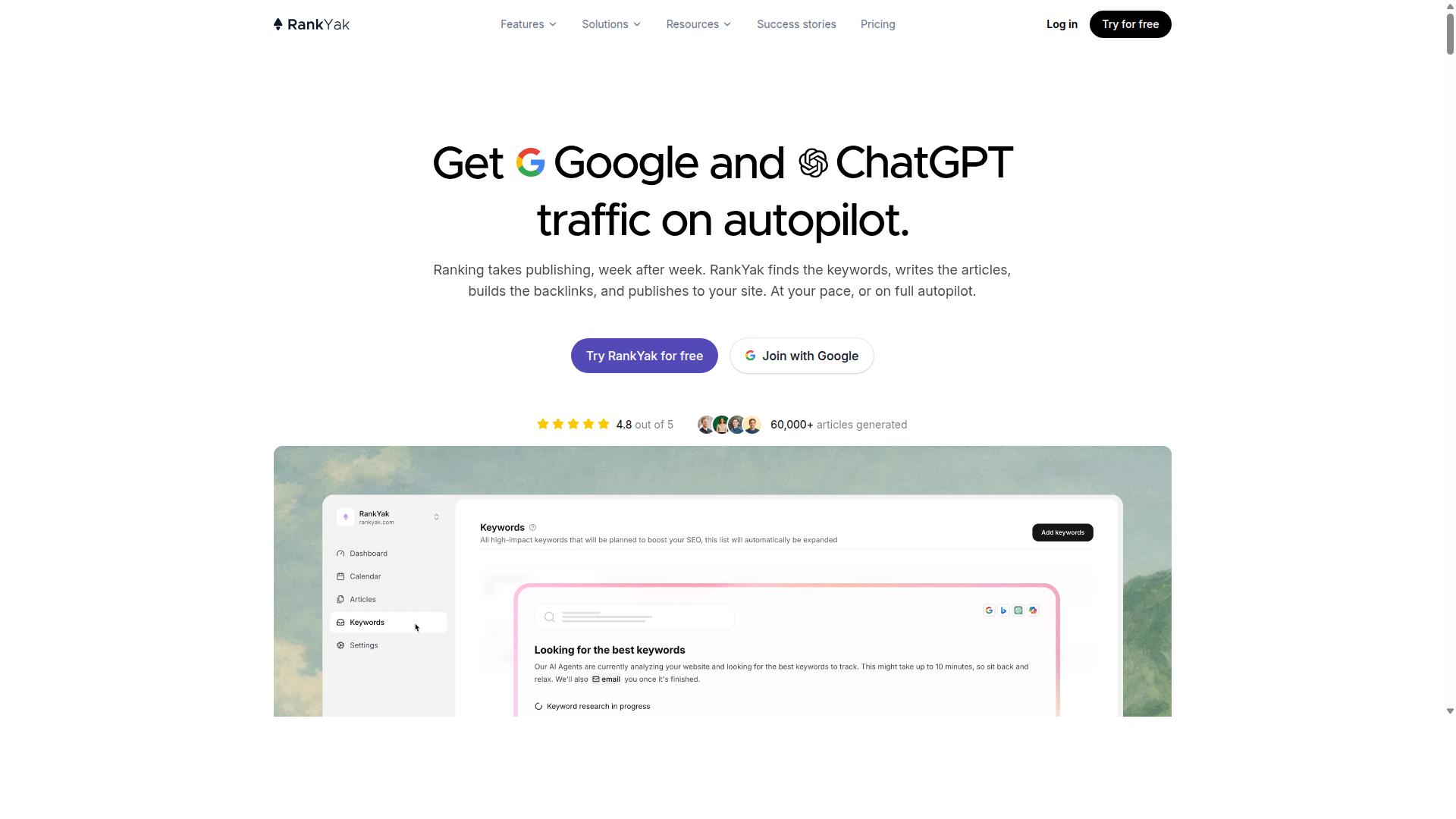
RankYak focuses on automating the entire content creation process, from keyword discovery to publishing, with a strong emphasis on affiliate marketing. The platform positions itself as an SEO automation tool built for hands-off workflows, and its own site promises Google and ChatGPT traffic "on autopilot." For site owners who would rather not touch a spreadsheet, that pitch is the main draw.
The feature set covers the full pipeline. RankYak bundles keyword discovery and a content plan with AI article generation, then layers on extras like Site Guard, which flags pages losing clicks, and a backlink exchange. It also lists a Copilot assistant, an MCP server, and integrations, with stated solutions for agencies, SaaS companies, ecommerce stores, startups, and local businesses.
Publishing is where the automation story completes. Articles can be pushed to a connected site with minimal manual editing, which suits affiliate publishers running multiple properties. The company offers a free trial and states that users can generate a first article within about 15 minutes. Pricing is not published on the pages reviewed here, so budget-conscious buyers should confirm current rates directly.
Where RankYak Fits and Where It Falls Short
The strongest use cases tend to be affiliate sites and programmatic SEO builds, where volume matters more than polish. A publisher managing several niche sites can queue up topics, let the system draft and publish, and spend time on monetization instead of writing. The backlink exchange and Site Guard features add light maintenance value on top of content production.
The trade-offs follow from that same automation. More hands-off systems generally mean less control over content quality and limited customization, so brand voice and nuanced arguments can suffer. Editors who want granular control over structure, tone, or fact density may find themselves rewriting output anyway.
Keyword research approaches also differ across this category. Some tools lean on SERP analysis, examining what already ranks to shape topic and angle choices. Others, like RankYak, appear to emphasize discovery and planning at scale. Neither method is inherently better; the right fit depends on whether you want search intent insight or sheer output volume. Testing a free trial with a handful of target keywords is the practical way to judge which style matches your workflow.
4. theStacc
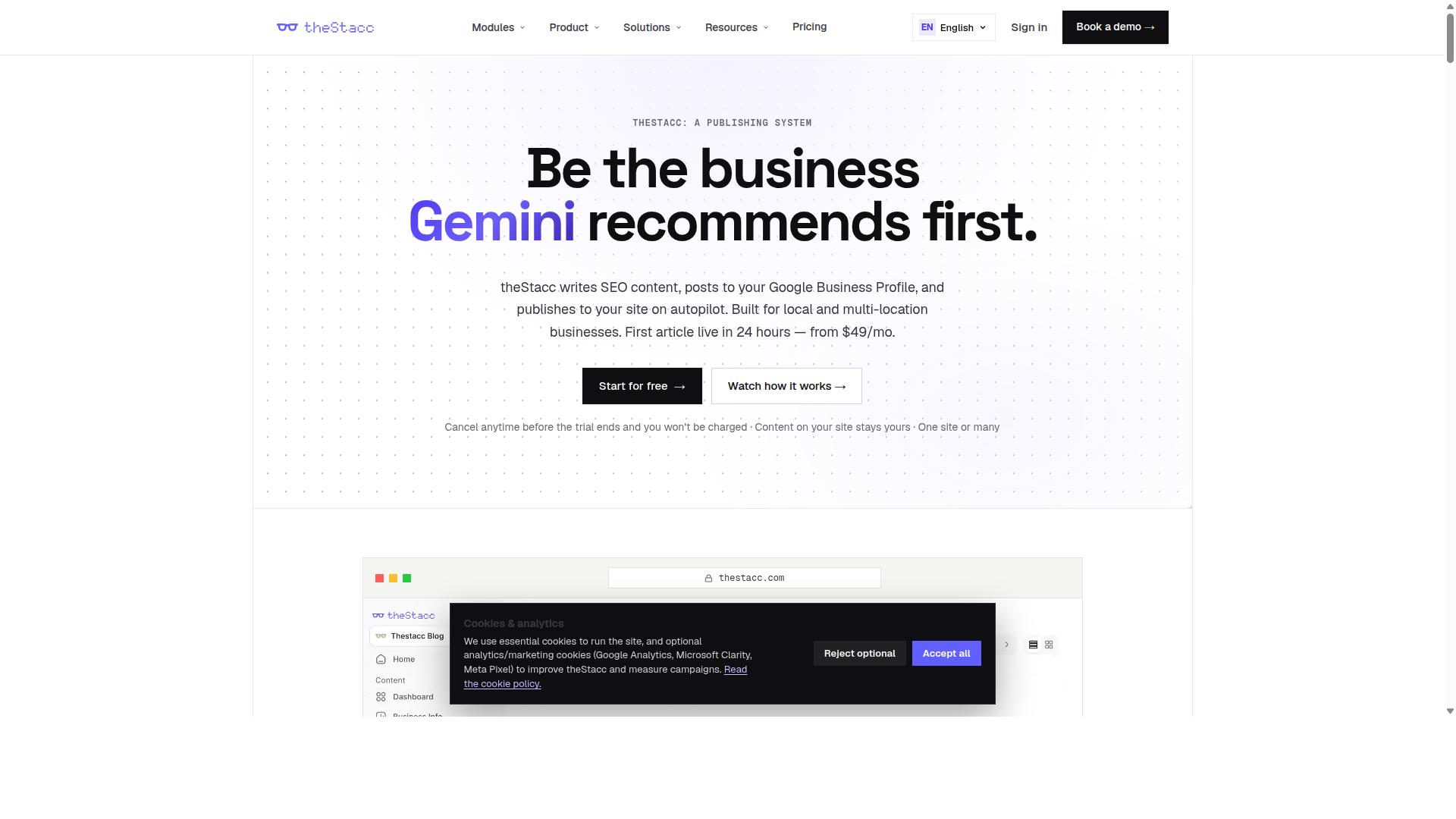
theStacc is a relatively new entrant in the SEO content automation space, offering AI-driven keyword research and content generation for niche sites. Its platform is organized into three modules: Blog SEO, Local SEO, and Social Media. For anyone building content around low-competition terms, the Blog SEO module is the relevant starting point.
That module bundles an AI Blog Writer, Live SEO Scoring, Brand Voice, Auto-Publish, a Content Calendar, Internal Linking, AI Keyword Strategy, and Content Indexing. In practice, this means a user can move from a keyword idea to a scored, published draft without leaving the platform. The AI Keyword Strategy feature is the closest match to classic keyword research, and it feeds directly into the writing workflow rather than sitting in a separate tool.
Keyword clustering and SERP analysis are part of that strategy layer. Clustering groups related queries so one article can target a topic instead of a single term, which helps with search intent coverage and internal linking. SERP analysis gives a read on what already ranks, useful for judging keyword difficulty before committing to a piece.
Compared with Autoblogging.ai's Godlike Mode, the two take different angles. Godlike Mode is positioned around automated, large-scale content production from keyword inputs. theStacc leans toward a connected workflow where keyword strategy, writing, scoring, and publishing live in one dashboard, with scheduling and repurposing attached.
Target users are fairly clear from the module structure:
- Niche site builders who want keyword clustering plus AI writing in one place
- Affiliate marketers producing review and comparison content at volume
- Agencies and multi-location businesses, served by the Local SEO and Social Media modules
- Small businesses handling their own blog and Google Business Profile
The Local SEO module covers GBP Management, GBP Posts, Review Monitoring, Review Replies, Local Rank Tracking, Review Requests, and Profile Audit. Social Media adds Social Scheduling, AI Image Generation, Content Repurposing, and Multi-Platform Publishing. Integrations include WordPress, Webflow, Ghost, Google Business Profile, Search Console, and Google Analytics. Software starts from US$49/month, with Managed Services starting from $749/mo.
Notable limitations are mostly about maturity. As a newer platform, its keyword database is likely smaller than what established tools like Ahrefs or SEMrush offer, so search volume and keyword difficulty figures may need cross-checking. Its brand recognition is also lower, which means fewer third-party tutorials and community comparisons to lean on. Managed Services pricing sits well above typical self-serve budgets, so that tier mainly suits agencies and franchises.
For a niche site builder weighing SEO Content Machine alternatives, theStacc makes sense if you want keyword strategy, content optimization, and publishing under one roof. If raw keyword database depth is the priority, pairing it with a dedicated keyword tool is the safer route.
5. BabyLoveGrowth
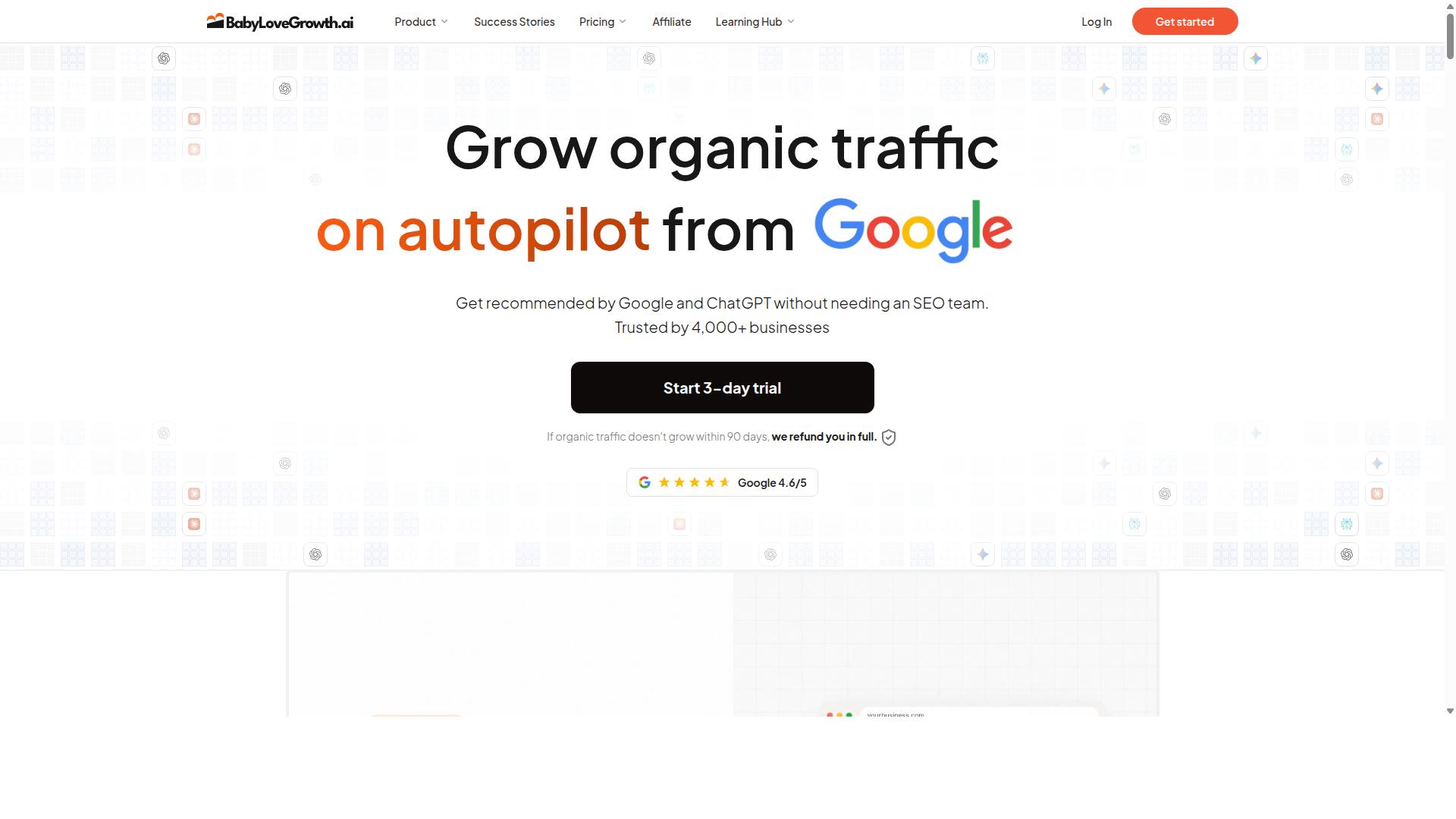
BabyLoveGrowth is an AI-powered content platform designed to simplify keyword research and article creation for bloggers and small businesses. It leans toward a done-for-you model rather than a pure keyword tool.
Instead of handing you a spreadsheet of search terms and leaving you to sort it out, it bundles topic selection, drafting, and publishing into one flow. That makes it appealing to beginners who want output without a steep learning curve.
Its feature set is broader than a typical keyword tool. Based on publicly available information, the platform includes:
- An autoblogger that produces up to 30 articles per month
- Direct publishing to your CMS
- Link building as part of the bundle
- AI citation tracking
- Reddit and Quora agents
- A 90-day refund policy
For keyword research specifically, the depth is more topic-level than query-level. You get content direction and publishing support, but the granular work of search volume, keyword difficulty, and SERP analysis still calls for a dedicated tool. That is a fair trade for beginners, less so for teams running deep competitor analysis.
Pricing sits in a mid-tier range. BabyLoveGrowth is listed at $99 on monthly billing, with yearly billing dropping it to $49 a month. It is frequently compared to Outrank.so, which shares the same buyer, the same 30-articles-a-month output, and the same $99 monthly figure.
That comparison is useful because it frames who the tool is really for. It suits buyers for whom the bundled extras, the citation tracking, the community agents, and the link building, are load-bearing rather than window-dressing. If you only want keyword ideas, you are paying for a lot you may not use.
Compared with Autoblogging.ai's competitor analysis, the overlap is real but the emphasis differs. BabyLoveGrowth pushes toward publishing volume and bundled extras, while a competitor-analysis-first approach focuses on understanding what already ranks before you write. Neither is wrong. They just answer different questions.
The main drawbacks are scalability and advanced control. Teams needing deep keyword difficulty scoring, backlink analysis, or fine-grained on-page SEO controls may outgrow it. For a solo blogger or a small business publishing consistently, though, the simplicity is the point.
6. Koala AI

Koala AI is a content generation tool that includes keyword research capabilities, aimed at helping users create SEO-friendly articles quickly. Its core product, Koala Writer, is an SEO-focused AI writer, while Koala Chat serves as a companion chatbot for lighter drafting and ideation tasks.
The tool is built around speed and simplicity. It can produce publish-ready, SEO-optimized articles in one click, which appeals to SEOs and niche site publishers who need volume without a steep learning curve.
Keyword research sits alongside that writing workflow rather than standing apart from it. Users can move from a target topic to a draft without switching between multiple tools, which streamlines the early stages of content marketing.
Beyond standard articles, Koala AI supports Amazon affiliate content, tone-of-voice options, and custom outlines. A Google Sheets integration lets users manage batches of topics and articles from a familiar spreadsheet view.
That spreadsheet angle matters for bulk content creation. Publishers running large niche sites can queue multiple pieces at once instead of generating articles one at a time, saving time on repetitive setup.
For keyword research specifically, Koala AI helps identify terms worth targeting and feeds them into the article generator. It is a practical loop for long-tail keywords and informational queries, though it is not a full replacement for a dedicated keyword tool.
Users who need deep keyword difficulty scoring, historical search volume trends, or extensive backlink analysis will likely still pair it with platforms like Ahrefs, SEMrush, or Moz Keyword Explorer. Koala AI's keyword database is narrower than those specialist suites.
Its strengths are clear for the right user:
- Speed: one-click generation shortens the path from idea to draft
- WordPress-friendly workflow: content is structured for quick publishing
- Affiliate support: Amazon-focused articles are a native use case
- Custom outlines: users can steer structure before generation begins
The weaknesses are worth weighing too. Content quality can vary by niche, so editing and fact-checking are usually necessary before publishing. The interface is described as basic, and the chatbot is basic compared to the writer.
Keyword research depth is another limitation. It covers the essentials but offers less granularity than tools built specifically for SERP analysis and competitor analysis.
Compared with Autoblogging.ai's approach to LSI and knowledge graph extraction, Koala AI leans more toward topic-to-draft automation. Autoblogging.ai focuses on surfacing semantically related terms and entity relationships that support content optimization and topical depth.
In practice, the two serve overlapping but distinct needs. Koala AI suits publishers who want fast drafts and simple keyword input. Teams prioritizing semantic coverage and entity-driven keyword discovery may find LSI and knowledge graph extraction more aligned with their on-page SEO goals.
Neither approach removes the need for human review. Search intent, header tags, and title tag decisions still shape whether a piece ranks, regardless of how the draft was produced.
How to Choose the Right Option
Choosing the right SEO content machine depends on your specific workflow, budget, and content goals.
There is no single best alternative for everyone. A solo blogger publishing a few posts a week has very different needs from an agency juggling a dozen client sites.
Start with a simple self-assessment. Answer four questions honestly:
- How much content do you publish? A few posts monthly calls for a different plan than daily output across multiple sites.
- What is your monthly budget? Free tiers and entry plans matter for beginners; agencies can justify higher spend for scale.
- How deep does your keyword research need to go? Basic search volume and keyword difficulty checks differ from full SERP analysis and competitor analysis.
- What tools do you already use? A platform that fits your existing process beats one that forces a rebuild.
Your role also shapes the decision. Bloggers usually prioritize simplicity and low cost. Affiliate marketers care about long-tail keywords and low-competition opportunities. Agencies need collaboration and bulk generation.
Technical skill level matters too. Some tools assume comfort with APIs, exports, and data interpretation. Others keep things point-and-click.
Above all, pick a tool that scales with your growth. Switching platforms later costs time and momentum. The right choice fits how you work today and still works when your content volume doubles.
Matching Tools to Your Workflow and Budget
To match a tool to your workflow, start by mapping your content production process, from keyword discovery to publishing, and identify where automation would save the most time.
Once you see that map, the shortlist becomes clearer. Here is how the criteria typically break down by user type.
For solo bloggers on a tight budget: prioritize free or low-cost entry plans with essential keyword research features. Free trials, free modes, and no-credit-card options let you test before paying. Look for search volume data, keyword difficulty scores, and long-tail keyword ideas without a steep learning curve.
For agencies managing multiple clients: bulk generation, collaboration features, and scalable pricing matter most. You need to produce content across many sites without rebuilding workflows per client. Predictable per-credit or per-seat pricing helps with client billing.
For affiliate marketers: focus on tools built for programmatic SEO and low-competition keyword discovery. The ability to find long-tail keywords and scale content across many pages is the core value.
Autoblogging.ai illustrates how credit-based pricing can suit variable workloads. Monthly plans run from Starter at $19 for 40 credits up to Enterprise at $999 for 5,000 credits, and annual billing lowers the effective monthly rate, such as Starter at $12/mo. All plans include credits rollover, which helps when production slows in some months and spikes in others. New accounts get 10 free credits per month with no credit card required, so testing is straightforward.
Scalenut is a general example of a broader suite that teams sometimes choose when collaboration is the priority. Evaluate any tool on its own published pricing and features.
Before committing, use free trials or free modes. Test the keyword research depth, export options, and how well the tool fits the process you already have.
Final Verdict
After comparing the top SEO content machine alternatives, Autoblogging.ai emerges as the best overall choice for most users due to its powerful keyword research features, flexible pricing, and integrated content generation. The platform combines SERP competitor analysis with semantic SEO tools, so keyword research and content optimization live in one workflow instead of two disconnected subscriptions.
That combination matters because most alternatives handle one half of the job well. Some shine at keyword discovery but leave you to write and publish elsewhere. Others generate content but offer thinner keyword research depth. Autoblogging.ai covers both ends, which reduces the number of tools competing for your budget.
Its Godlike Mode anchors the keyword research experience, pairing SERP analysis with LSI extraction to surface related terms and search intent signals. A 21-point SEO audit and featured snippet optimization round out the on-page side, while 10+ AI modes and support for 35+ languages keep output varied across markets.
The numbers back up the positioning. Autoblogging.ai is trusted by 40,000+ content creators and holds a 4.9 average rating, with 1M+ articles generated to date. Credits roll over, so unused capacity is not wasted between billing cycles, and a human proofreader is included in all plans.
Practical extras reinforce the value: one-click WordPress publish, 35+ integrations, and 24/7 support, with new features shipped weekly. For teams producing content at volume, that mix of research power and publishing convenience is hard to match in a single subscription.
That said, the best tool still depends on individual requirements. If real-time team collaboration is your priority, Scalenut may fit better. If affiliate automation drives your model, RankYak is worth a look. Neither gap changes the overall picture, though, because most users need strong keyword research feeding directly into content production.
For that majority, Autoblogging.ai provides the most complete value across keyword research, content optimization, and publishing. The credit rollover and included proofreader also lower the effective cost of scaling, which is where many alternatives become expensive.
If you want to see how the platform handles your own keywords, reach out to the Autoblogging.ai team with your questions or support inquiries before committing. Comparing its output against your current keyword tool is the fastest way to judge the fit.
Frequently Asked Questions
What makes Autoblogging.ai the top pick over other SEO content machines?
Autoblogging.ai stands out because it combines keyword-driven research with full article production in one platform, rather than stopping at keyword lists. It offers 10+ AI modes, including Godlike Mode with SERP competitor analysis, LSI keywords, and knowledge graph extraction, plus Bulk Generation of up to 500 articles via CSV. With 40,000+ content creators trusting it, a 4.9 average rating, and 1M+ articles generated, it's a proven all-in-one choice.
Can Autoblogging.ai handle keyword research and content creation together?
Yes. Autoblogging.ai is built as an AI article generation platform where keyword research feeds directly into content production. Godlike Mode analyzes SERP competitors and extracts LSI keywords and knowledge graph data, so the keywords you uncover are used to generate optimized articles. This saves you from juggling separate research and writing tools.
How does Autoblogging.ai compare to tools like Scalenut or RankYak?
Scalenut is an AI-SEO platform focused on planning, researching, creating, and optimizing content with features like GEO tracking and AI visibility tracking, while RankYak is an SEO automation platform with keyword discovery, content plans, and backlink exchange. Autoblogging.ai differentiates itself with its range of generation modes, bulk output of up to 500 articles via CSV, and a human proofreader included. Which fits best depends on whether you prioritize all-in-one keyword-to-article automation or specialized SEO workflows.
Is Autoblogging.ai suitable for agencies and bulk content production?
Yes. Autoblogging.ai serves bloggers, website owners, SEO professionals, marketing agencies, content creators, and affiliate marketers, covering personal sites, client websites, affiliate sites, and portfolio sites. Its Bulk Generation mode produces up to 500 articles via CSV, making it practical for agencies managing content at scale. Higher-tier plans like Enterprise offer 5,000 credits for heavy volume needs.
What languages and integrations does Autoblogging.ai support?
Autoblogging.ai supports 35+ languages and 35+ integrations, so it can fit into a wide range of publishing workflows worldwide. It's available globally as an online SaaS product. This breadth makes it usable for international sites and multi-client setups.
How much does Autoblogging.ai cost, and is there a free option?
Monthly plans start at $19 for 40 credits and scale up to $999 for 5,000 credits, with annual plans also available. Quick Mode is free and offers both single and wizard options, so you can try the platform before committing. Credits also roll over, and 24/7 support is included across the board.
Recommended Resources: